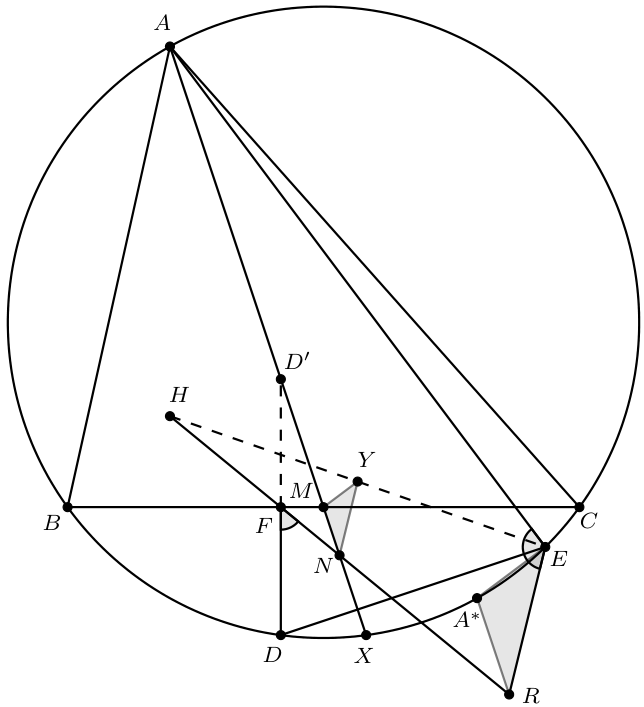
Let X be the intersection point of AM and Γ other than A, then
∠XDC=∠XAC=∠MAC=∠BAD=∠BCD,
that is, DX∥BC. Since AD,AX are isogonal lines with respect to ∠BAC, BDXC is an isosceles trapezoid, hence the reflection D′ of D with respect to BC is the reflection of X with respect to M. Let A∗ be the antipode of A with respect to Γ, and let Y be the midpoint of HE, then M is the midpoint of HA∗, so △A∗ER is the image of △MYN under a homothety centered at H with ratio 2. Since AX is perpendicular to DE, and AX,AA∗ are isogonal lines with respect to ∠DAE, DXA∗E is an isosceles trapezoid. Note that (mod 360∘)
∠FMA=∠DXA=90∘−∠EDX=90∘−∠A∗ED=∠(XA,A∗E)=∠AMY,
so combined with FM=21⋅DX=21⋅A∗E=MY, we obtain that Y is the reflection of F with respect to AM.
Since ∠MAE=∠DAA∗=∠HAM, AE is the reflection of line AH with respect to AM. Therefore
180∘−∠DFR=∠(NF,HA)=∠(AE,YN)=∠AER.