Let the radii of the circles c1, c2, c3 be r1, r2, r3, and the radii of the circles k1, k2, k3 be R1, R2, R3, respectively (Fig. 28). By assumptions,
R1+R2R2+R3R3+R1=∣K1K2∣=21∣C1C2∣,=∣K2K3∣=21∣C2C3∣,=∣K3K1∣=21∣C3C1∣,
which sum up to 2R1+2R2+2R3=21(∣C1C2∣+∣C2C3∣+∣C3C1∣). The assumptions also imply inequalities
r1+R3r2+R1r3+R2≤21∣C1C2∣,≤21∣C2C3∣,≤21∣C3C1∣,R3+r2R1+r3R2+r1≤21∣C1C2∣,≤21∣C2C3∣,≤21∣C3C1∣,
which sum up to 2r1+2r2+2r3+2R1+2R2+2R3≤∣C1C2∣+∣C2C3∣+∣C3C1∣.
i) Altogether, we obtain the inequality 2r1+2r2+2r3≤21(∣C1C2∣+∣C2C3∣+∣C3C1∣), which implies r1+r2+r3≤41(∣C1C2∣+∣C2C3∣+∣C3C1∣) as desired.
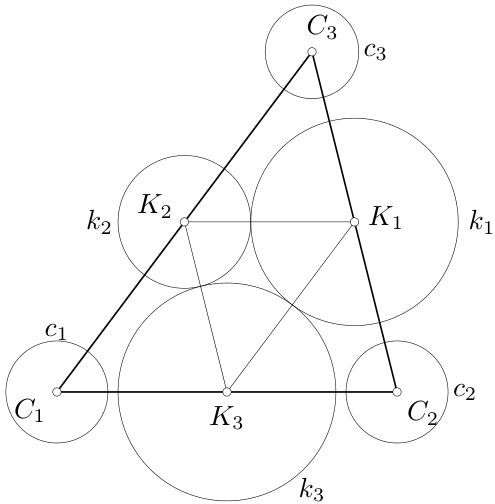
Figure 28
ii) Suppose that r1+r2+r3=41(∣C1C2∣+∣C2C3∣+∣C3C1∣). Then all inequalities above must hold as equalities. The equalities r1+R3=21∣C1C2∣=r2+R3 imply r1=r2, analogously r1=r3. Denoting r=r1=r2=r3, we get
r+R3=21∣C1C2∣=R1+R2,
r+R2=21∣C1C3∣=R1+R3,
where summing side-by-side gives 2r+R2+R3=2R1+R2+R3, i.e., R1=r. Analogously, R2=R3=r. Thus all sides of the triangle C1C2C3 have length 4r.