Let be an acute triangle with , and let be the circumcircle of . Points and lie on so that and intersect on the external angle bisector of . Suppose that the tangents to at and intersect at a point on the same side of as , and that and intersect at and , respectively. Let be the centre of the excircle of triangle opposite the vertex .
Prove that bisects .
IMO Shortlist
Solution
Claim. Quadrilateral is cyclic, and its circumcentre is .
Proof. As is the midpoint of , and lie on , and and are the second intersections of and with , we have that is cyclic.
Let the parallel to through intersect and at and , respectively. Then is the intersection of the tangents to at and , so . As , is similar to , so as well. Hence, the perpendicular bisector of is the internal bisector of , which is the external bisector of . Analogously, the perpendicular bisector of is the external bisector of . This means that the circumcentre of is the intersection of the external bisectors of and , which is .
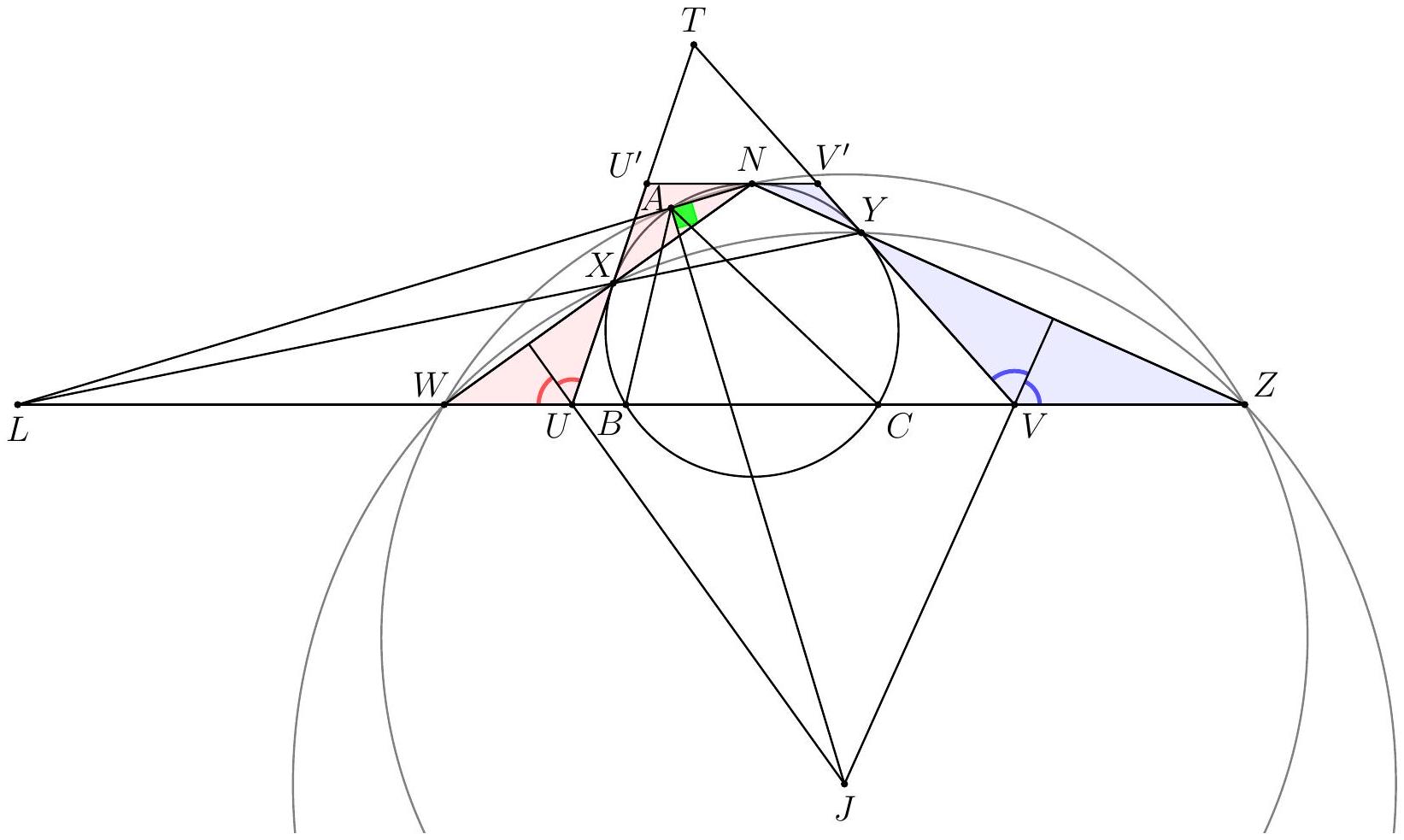
Let intersect at , so passes through as well. By power of a point from to and circle , we have that , so is also cyclic. Thus, is the Miquel point of quadrilateral . As is cyclic with circumcentre and its opposite sides and intersect at , we have that . Since is the external bisector of , this implies that is the internal bisector of .
Solution 2:
Let the internal and external angle bisectors of intersect at and , respectively. Let intersect circle again at , and let be the intersection of the tangents to at and . Let be the -excircle of , and let be the incircle of .
Claim. The points , , and are collinear.
Proof. Note that and are the polars of and with respect to . By La Hire's Theorem, is the polar of with respect to . As , also lies on the polar of , thus proving the collinearity.
Claim. The incentre of is .
Proof. We have that , so bisects . Similarly, bisects , so is the incentre of .
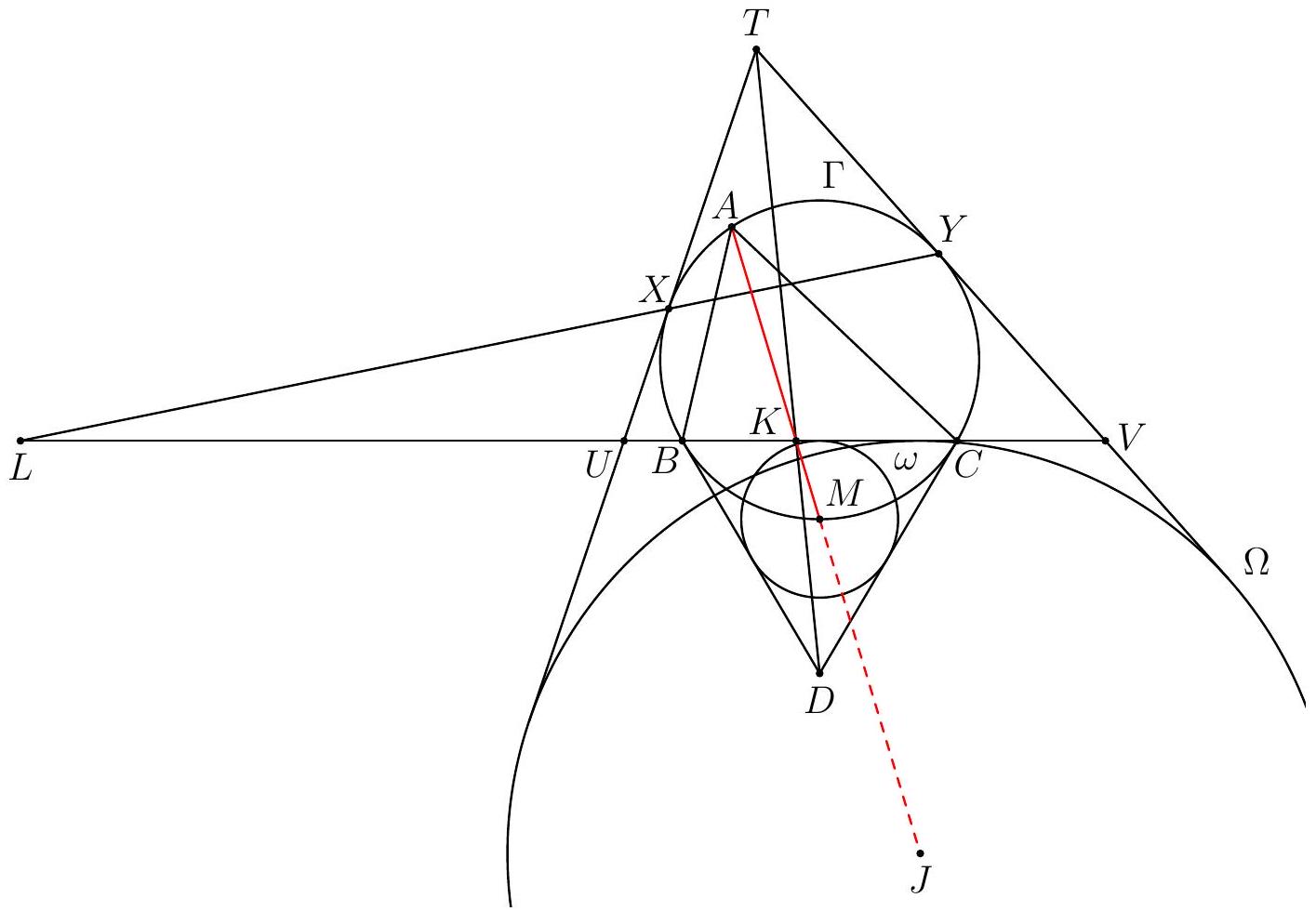
Claim. The intersection of the common external tangents of and is .
Proof. Let be the intersection of the common external tangents of and . As and are both tangent to and lie on the same side of opposite to , lies on . As is the intersection of the common external tangents of and and is the intersection of the common external tangents of and , by Monge's theorem lies on . As lies on both and , it is the same point as .
Hence, is collinear with the centres of and , which are and , respectively. As and both lie on the bisector of , so does .
Want a route through all this instead of an archive? The track
puts 2,604 problems in a working order, from Junior Challenge level to the IMO shortlist.