Prove that every positive real number satisfies (x+1)(x+2)(x+5)≥36x.
Solutions — 3
Solution 1
The given inequality is equivalent to x3+8x2−19x+10≥0. Note that x3+8x2−19x+10=(x−1)2(x+10). As (x−1)2≥0 and x+10>0 for positive x, this inequality holds indeed.
Solution 2
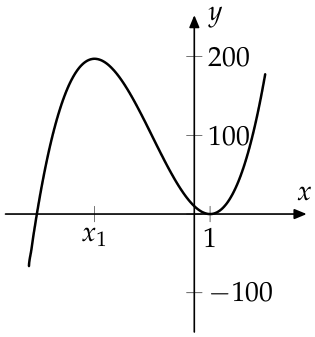
Let f(x)=x3+8x2−19x+10. The given inequality is equivalent to f(x)≥0. Note that f′(x)=3x2+16x−19. As D=162−4⋅3⋅(−19)>0, the function f′ has two real roots. Let the smaller and the larger root be x1 and x2, respectively; then x2=1 and x1<0. As the coefficient of the quadratic term of f′(x) is positive, f′ is increasing at 1 whence the values of f′ are negative in the interval (x1;1) and positive in the interval (1;∞). Hence f is decreasing in the interval (x1;1) and increasing in the interval (1;∞) (Fig. 39). Thus f(x)≥f(1)=0 holds for all x in the interval (x1;∞) that includes every positive x.
Fig. 39
Solution 3
For every positive integer k, the AM-GM inequality implies k+1x+1⋅k≥k+1x⋅1k. Using this inequality for k=1,k=2, and k=5, we obtain the inequalities x+1≥2x, x+2≥33x, x+5≥66x, respectively. The desired result is now obtained by multiplying the corresponding sides.
Want a route through all this instead of an archive? The track
puts 2,604 problems in a working order, from Junior Challenge level to the IMO shortlist.
Source: MathNet,
licensed CC-BY-4.0.
Statement reproduced verbatim; metadata (topic, difficulty) added by this project.