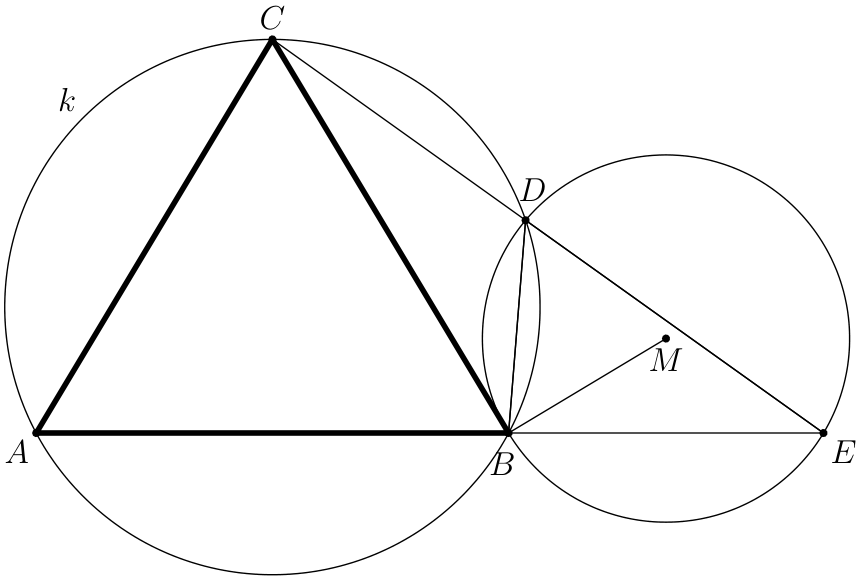
Let ABC be an isosceles triangle with AC=BC and circumcircle k. The point D lies on the shorter arc of k over the chord BC and is different from B and C. Let E denote the intersection of CD and AB. Prove that the line through B and C is a tangent of the circumcircle of the triangle BDE.
Solution
We denote the center of the circumcircle of the triangle BDE by M and ∠BAC=∠CBA by α. Since the quadrilateral ABDC is cyclic, we obtain ∠BDE=α. By the inscribed angle theorem, ∠BME=2α and thus ∠EBM=∠MEB=90∘−α. Therefore, 180∘=∠CBA+∠MBC+∠EBM=α+∠MBC+90∘−α=∠MBC+90∘ holds and we get ∠MBC=90∘, completing the proof.
Figure 1: Problem 6
Want a route through all this instead of an archive? The track
puts 2,604 problems in a working order, from Junior Challenge level to the IMO shortlist.
Source: MathNet,
licensed CC-BY-4.0.
Statement reproduced verbatim; metadata (topic, difficulty) added by this project.