Maths Olympiad Prep

Library / /15 of 27

, 2016

Geometry Difficulty 5.8 AIME, harder Prove it India

Let ABCABC be an acute triangle with circumcircle Γ\Gamma. Let A1A_1, B1B_1 and C1C_1 be respectively the midpoints of the arcs BACBAC, CBACBA and ACBACB of Γ\Gamma. Show that the inradius of triangle A1B1C1A_1B_1C_1 is not less than the inradius of triangle ABCABC.

Solution

Rotate the triangle around the centre of Γ\Gamma by 180180^\circ. Then A1A_1, B1B_1, C1C_1 respectively go to A2A_2, B2B_2, C2C_2. These are respectively the midpoints of the minor arc BCBC, CACA and ABAB. We see that A1B1C1A_1B_1C_1 and A2B2C2A_2B_2C_2 are congruent triangles and hence have the same in-radii. But we know that A2A_2 is the intersection of the angle bisector of BAC\angle BAC with Γ\Gamma and similar descriptions hold for the other two points.
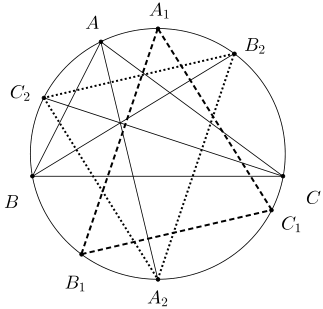
Figure 1
---

Observe that C2A2A=C2CA=C/2\angle C_2A_2A = \angle C_2CA = \angle C/2 and B2A2A=B2BA=B/2\angle B_2A_2A = \angle B_2BA = \angle B/2. Hence A2=(B/2)+(C/2)=(πA)/2\angle A_2 = (\angle B/2) + (\angle C/2) = (\pi - \angle A)/2. Similarly we get other angles:
B2=(πB)/2,C2=(πC)/2. \angle B_2 = (\pi - \angle B)/2, \quad \angle C_2 = (\pi - \angle C)/2.
We know that for any triangle ABCABC its inradius is given by
r=4Rsin(A/2)sin(B/2)sin(C/2), r = 4R \sin(A/2) \sin(B/2) \sin(C/2),
where RR is its circumradius. If rr and r1r_1 are respectively the inradii of ABC\triangle ABC and A2B2C2\triangle A_2B_2C_2, then we have
rr1=sin(A/2)sin(B/2)sin(C/2)sin((πA)/4)sin((πB)/4)sin((πC)/4). \frac{r}{r_1} = \frac{\sin(A/2) \sin(B/2) \sin(C/2)}{\sin((\pi - A)/4) \sin((\pi - B)/4) \sin((\pi - C)/4)}.
Now we use another known identity in a triangle:
1+4sin(πA4)=sinA2. 1 + 4 \prod \sin \left( \frac{\pi - A}{4} \right) = \sum \sin \frac{A}{2}.
Thus we obtain
rr1=4sin(A/2)(sin(A/2))1. \frac{r}{r_1} = \frac{4 \prod \sin(A/2)}{(\sum \sin(A/2)) - 1}.
We have to show that rr1r \le r_1. Equivalently we have to prove that
1+4sin(A/2)sin(A/2). 1 + 4 \prod \sin(A/2) \le \sum \sin(A/2).
But we know that
sin(A/2)3(sin(A/2))1/3. \sum \sin(A/2) \ge 3 \left( \prod \sin(A/2) \right)^{1/3}.
Thus it is sufficient to prove that
1+4sin(A/2)3(sin(A/2))1/3. 1 + 4 \prod \sin(A/2) \le 3 \left( \prod \sin(A/2) \right)^{1/3}.
Introducing x=(sin(A/2))1/3x = \left( \prod \sin(A/2) \right)^{1/3}, this inequality is equivalent to
4x33x+10. 4x^3 - 3x + 1 \ge 0.
However it is easy to see that 4x33x+1=(2x1)2(x+1)4x^3 - 3x + 1 = (2x - 1)^2(x + 1). Hence 4x33x+104x^3 - 3x + 1 \ge 0 for all positive xx. This completes the proof.

Want a route through all this instead of an archive? The track puts 2,000 problems in a working order, from AMC 10 level to the IMO shortlist.

Source: MathNet, licensed CC-BY-4.0. Statement and solution reproduced as published; topic and difficulty added by this site.