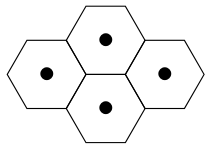
Answer: Olga has a winning strategy.
The game cannot go on forever. Draw a large hexagon enclosing all 2017 counters in play after the 2017th move, as in Figure 1. While it will be possible to place future counters in the hexagonal frame at distance 1 from the shaded part (i.e. immediately surrounding it), where D and E are located, it will be impossible to reach cells at distance 2 from the shaded part, where F is located. Indeed, in order to place a counter at F, first counters must be placed on cells D and E.
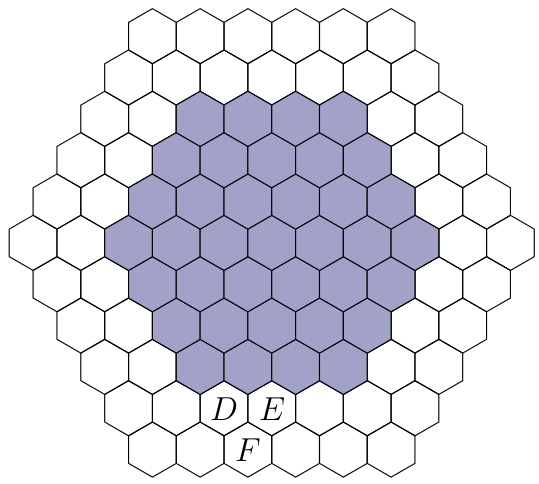
Figure 1: A large shaded hexagon enclosing all 2017 counters in play after the 2017th move.
Assume that the cells E1,E2,…,En to the right of E contain counters, but the next cell to the right is En+1 and it is empty. Observe that the counter on En−1 has been placed before the counter on En, because otherwise the forbidden rhombus is formed by the cells En−1,En and two ancestors of En in the previous row. By analogous reasoning considering the moment of placing the counter on En−1 one can prove that the counter on En−2 has been placed before the counter on En−1, etc. Thus we conclude that the counter on D has been placed before the counter on E. But changing the direction of our reasoning to the left we similarly conclude that counter on E has been placed before the counter on D. A contradiction.
Now, let Olga place her first counter in any hexagon H, and then respond to each of Sasha's successive moves by symmetry, choosing to place her counter on the reflexion in H of his chosen hexagon (in other words, diametrically opposite to his with respect to H). It is clear that the gameplay will be completely symmetrical after each of Olga's moves. Hence she may respond, even under the additional rule, to any move Sasha might make. It is also evident that she will never complete a forbidden rhombus if Sasha did not already do so before. Hence Olga is always certain to have a legal move at her disposal, and so will eventually win.