Denote by D the mid-point of BC. We offer two ways of doing part (a).
First way:
Continue the line segment AD through D to the point A′ chosen so that ∣A′D∣=∣DA∣=ma. Consider the triangles A′DC and ADB. Note that ∠A′DC=∠ADB, ∣BD∣=∣DC∣ and ∣A′D∣=∣AD∣, by construction.
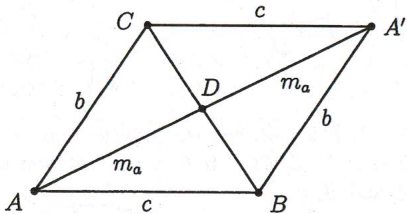
Hence, these triangles are congruent and so, in particular, ∣A′C∣=∣AB∣.
Now consider the triangle A′CA, and apply the triangle inequality to infer that
2ma=∣A′D∣+∣DA∣=∣A′A∣<∣CA∣+∣A′C∣=b+c.
Second way:
Two applications of the Cosine Rule tell us that
amacos∠BDA=ma2+(2a)2−c2and−amacos∠BDA=amacos∠CDA=ma2+(2a)2−b2.
Thus, eliminating cos∠BDA, we see that
4ma2=2(b2+c2)−a2.
Hence 2ma<b+c iff
2(b2+c2)−a2<b2+2bc+c2⟺b2+c2−a2<2bc⟺cos(∠BAC)<1,
which is true. In like manner, 2mb<c+a, 2mc<a+b, and so
2ma+2mb+2mc<(a+b)+(b+c)+(c+a)=2(a+b+c),
i.e. ma+mb+mc<a+b+c. This completes the proof of part (a).
b.
The numbers 2, 4, 5 are the side lengths of a triangle ABC with a=4, b=2, c=5 for which
ma2=42(b2+c2)−a2=221>10=bc.
Hence (i).
(ii) occurs in any triangle in which b=c, because, in such a case,
bc=b2=ma2+(2a)2>ma2.