Let be an acute triangle, and let , , be the feet of its altitudes from , , , respectively. The lines and cross at and the lines and cross at . Let be the midpoint of the side and let the line cross the circle again at . Finally, the parallel through to crosses the line at . Show that the triangle is isosceles.
Andrei Bâra
Nineteenth IMAR Mathematical Competition
Solution
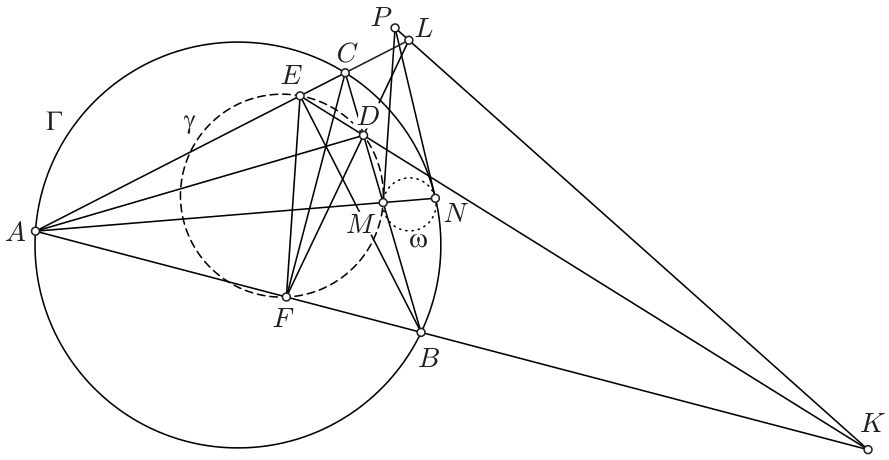
We will show that and are the tangents from to ; the conclusion then follows at once.
We first prove that is the tangent of at . The tangent of at is parallel to the tangent of at , which is in turn parallel to . Since is the parallel through to , it follows that is the tangent of at .
Next, we show that is the tangent of at . Since the factor homothety from the barycentre of the triangle exchanges the pairs (, ) and (, ), the tangent of at is parallel to the tangent of at ; and since the latter is parallel to , so is the former. Consequently, , the parallel through to , is the tangent of at .
By the preceding, is the radical axis of and . Since is a homothetic image of from , their radical axis is their common tangent at .
Consequently, is the other tangent of from if and only if is the radical centre of , and , which is the case if and only if lies on the radical axis of and . Since lies on , it is sufficient to show that is radical axis of and .
Finally, we prove that is radical axis of and . The powers of with respect to and are and , respectively. The two are equal since is cyclic, so lies on the radical axis of and . Similarly, lies on their radical axis, so is the radical axis of the two circles. This completes the solution.
Want a route through all this instead of an archive? The track
puts 2,604 problems in a working order, from Junior Challenge level to the IMO shortlist.