Maths Olympiad Prep

Library / /68 of 101

Geometry Difficulty 6.5 National olympiad Prove it Estonia

Let BEBE be an altitude of an acute triangle ABCABC and let PP be the point on side ABAB such that AP=AEAP = AE. Let NN be the point for which BCENBCEN is a parallelogram. The areas of the triangles AEPAEP and BNPBNP are equal. Lines NENE and ABAB intersect at QQ.

a) Prove that the median of triangle ABCABC drawn from the vertex CC intersects the line segment PQPQ.

b) Prove that in the triangle ABCABC, the bisector of the angle AA, the altitude drawn from the vertex BB and the median drawn from the vertex CC meet in one point.

Solution

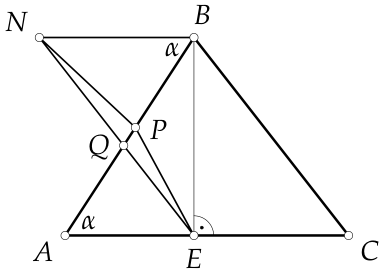
Figure 1
Fig. 40

Denote AC=bAC = b, AB=cAB = c, BAC=α\angle BAC = \alpha, and AE=AP=uAE = AP = u. As BCENBCEN is a parallelogram, BN=CE=buBN = CE = b-u and BNCEBN \parallel CE. The latter implies NBP=α\angle NBP = \alpha (Fig. 40). As QAE=QBN\angle QAE = \angle QBN and AQE=BQN\angle AQE = \angle BQN, triangles AQEAQE and BQNBQN are similar.

a) The triangles AEPAEP and BNPBNP have areas 12u2sinα\frac{1}{2}u^2 \sin \alpha and 12(bu)(cu)sinα\frac{1}{2}(b-u)(c-u) \sin \alpha, respectively. Thus u2=(bu)(cu)u^2 = (b-u)(c-u), whence cuu=ubu\frac{c-u}{u} = \frac{u}{b-u}. Similarity of triangles AQEAQE and BQNBQN implies AQBQ=AEBN\frac{AQ}{BQ} = \frac{AE}{BN} which, after defining BQ=xBQ = x, rewrites to cxx=ubu\frac{c-x}{x} = \frac{u}{b-u}. This equality reduces to a linear equation of xx, meaning that it has only one root. By equality cuu=ubu\frac{c-u}{u} = \frac{u}{b-u}, x=ux = u must be the only root. Thus BQ=u=APBQ = u = AP, whence the midpoint of the side ABAB coincides with the midpoint of the line segment PQPQ.

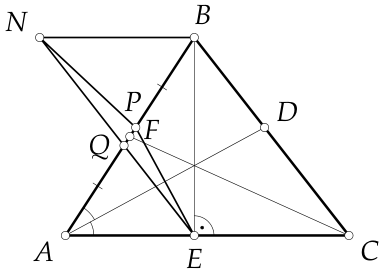
Figure 2
Fig. 41

b) Let FF be the midpoint of the side ABAB and let DD be the point of intersection of the bisector of angle AA with side BCBC (Fig. 41). By angle bisector theorem, BDCD=ABAC\frac{BD}{CD} = \frac{AB}{AC}. Since NENE and BCBC are parallel, triangles ABCABC and AQEAQE are similar, whence also triangles ABCABC and BQNBQN are similar. This and part a) of the problem together imply CEEA=BNBQ=ACAB\frac{CE}{EA} = \frac{BN}{BQ} = \frac{AC}{AB}. Consequently, AFFBBDDCCEEA=1ABACACAB=1\frac{AF}{FB} \cdot \frac{BD}{DC} \cdot \frac{CE}{EA} = 1 \cdot \frac{AB}{AC} \cdot \frac{AC}{AB} = 1, giving the desired result by Ceva's theorem.

Want a route through all this instead of an archive? The track puts 2,000 problems in a working order, from AMC 10 level to the IMO shortlist.

Source: MathNet, licensed CC-BY-4.0. Statement and solution reproduced as published; topic and difficulty added by this site.