Let be an odd positive integer, and consider an grid containing cells. Dionysus colours each cell either red or blue. A frog can hop directly between two cells if they have the same colour and share at least one vertex. Xanthias views the colouring, and wants to place frogs on of the cells so that any cell can be reached by a frog in a finite number of hops. Find the least value of such that Xanthias can always be successful regardless of the colouring chosen by Dionysus.
BMO Shortlist, 2022
Solution
Let be the graph whose vertices are all vertices of the grid and where two vertices are adjacent if and only if they are adjacent in the grid and moreover the two cells in either side of the corresponding edge have different colours.
The connected components of , excluding the isolated vertices, are precisely the boundaries between pairs of monochromatic regions each of which can be covered by a single frog. Each time we add one of these components in the grid, it creates exactly one new monochromatic region. So the number of frogs required is one more than the number of such components of .
It is easy to check that every corner vertex of the grid has degree , every boundary vertex of the grid has degree or and every 'internal' vertex of the grid has degree , or . It is also easy to see that every component of which is not an isolated vertex must contain at least four vertices unless it is the boundary of a single corner of the grid, in which case it contains only three vertices.
Writing for the number of components which are not isolated vertices, we see that in total they contain at least vertices. (As at most four of them contain vertices and all others contain vertices.) Since we also have at least components which are isolated vertices, then . Thus and therefore the minimal number of frogs required is .
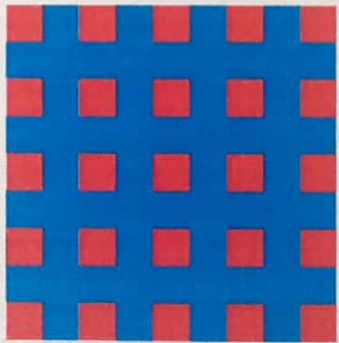
This bound for is achieved by putting coordinates with in the cells and colouring red all cells both of whose coordinates are even, and blue all other cells. An example for is shown below.
Want a route through all this instead of an archive? The track
puts 2,604 problems in a working order, from Junior Challenge level to the IMO shortlist.