a) As m is the perpendicular bisector, we have DA=DC and EA=EC. Thus △DEA≡△DEC.
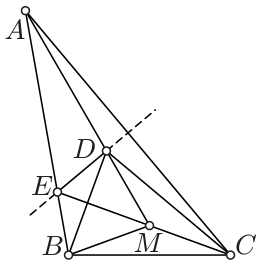
From DA=DC, we get ∠DCA=∠DAC=10∘. We have ∠DCE=∠DAE=20∘, so ∠BCE=20∘ and CE is the bisector of the angle BCD.
b) As ∠CDA=160∘, it follows ∠ADE=∠CDE=100∘=∠CBE.
We obtain ∠CEB=∠CED=60∘, so △CEB≡△CED (A.S.A.)
It follows that BE=BD. But ∠MEB=∠MED and ME=ME, so △MEB≡△MED (S.A.S.).
We infer that ∠EBM=∠EDM=180∘−∠CED−∠AME=180∘−60∘−40∘=80∘. But ∠BAM=20∘, so AB=AM.