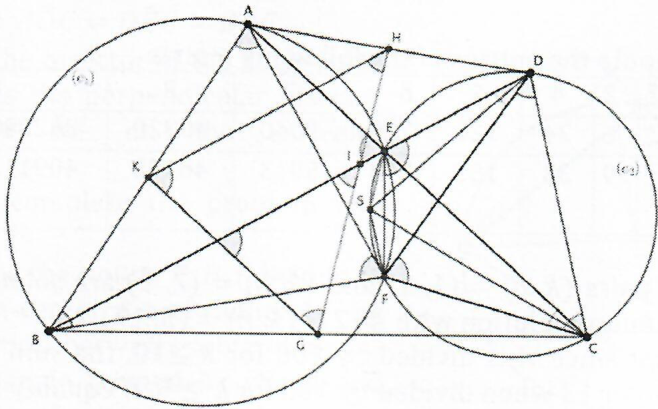
In a convex quadrilateral ABCD, its diagonals meet at E and H, G are the midpoints of the sides AD, BC, respectively. The circumcircles c1 and c2, of the triangles AEB and DEC, respectively, meet at point F=E. If the parallel from E to the line HG meets the circle c2 at S, prove that: FS∥CD.
Solutions — 2
Solution 1
In order to prove FS∥CD, it suffices FC=SD, or SC^D=FE^C. From the cyclic SEDC and FS∥CD we get SC^D=BE^S=BI^G, where I is the point of intersection of HG and BD. It suffices to prove that: BI^G=FE^C. Angle chasing gives AF^B=AE^B=DE^C=DF^C and BA^F=BE^F=FC^D. Figure 8 This means that AFB and CFD are similar with AB^F=FD^C. Moreover, DB^F=CA^F and BF^D=AF^D, where the triangles AFC and BFD are similar with similarity ratio AC/BD=AF/BF. If K is the midpoint of AB, then the triangle HKG has KH∥BD, KG∥AC with KG/KH=AC/BD=AF/BF and HK^G=AE^B=AF^B. Therefore, the triangle GKH is similar to AFB, and so KH^G=AB^F=FD^C=FE^C.
Figure 8
Solution 2
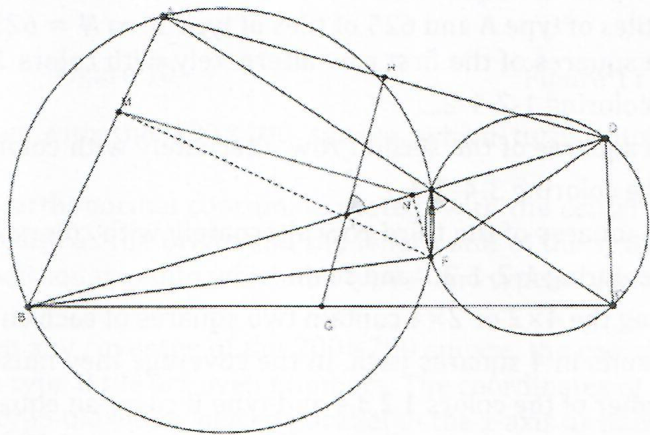
As in the first solution, it suffices to prove that: BI^G=FE^C. Let M, N be the projections of F to AB, BD, respectively. Then the line MN is a Simpson line of the complete quadrilateral and HG is the Newton-Gauss line. It is well-known that they are perpendicular. Therefore BI^G=HI^N=90∘−MN^B=90∘−MF^B=MB^F=FE^C, where in the third equality we used that MNFB is cyclic and in the last we used that AEFB is cyclic.
Figure 9
Want a route through all this instead of an archive? The track
puts 2,604 problems in a working order, from Junior Challenge level to the IMO shortlist.
Source: MathNet,
licensed CC-BY-4.0.
Statement reproduced verbatim; metadata (topic, difficulty) added by this project.