Maths Olympiad Prep

Library / /4 of 29

Geometry Difficulty 5.0 AIME, harder Prove it Silk Road Mathematics Competition

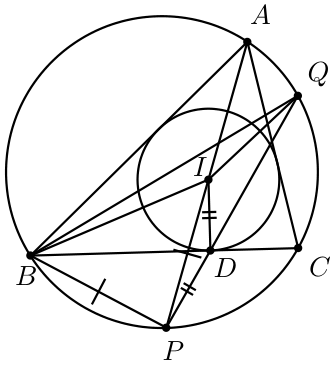
In a triangle ABCABC with incenter II, let PP be the intersection point of the bisector of the angle AA with the circumcircle other than AA, DD the point of tangency of the incircle to the side BCBC, and QQ the intersection point of PDPD with the circumcircle other than PP. Show that PI=QIPI = QI if PDPD is equal to the inradius.

Solution

Figure 1
In the triangle BIABIA, BIP=IBA+IAB=B/2+A/2\angle BIP = \angle IBA + \angle IAB = \angle B/2 + \angle A/2. On the other hand, PBI=PBC+CBI=A/2+B/2\angle PBI = \angle PBC + \angle CBI = \angle A/2 + \angle B/2, as PBC=PAC=A/2\angle PBC = \angle PAC = \angle A/2. Hence, in the triangle BPIBPI, BP=IPBP = IP.

Since QPB=BPD\angle QPB = \angle BPD and BQP=BAP=A/2=PAC=PBC=PBD\angle BQP = \angle BAP = \angle A/2 = \angle PAC = \angle PBC = \angle PBD, the triangles QPBQPB and BPDBPD are similar. In particular, PDPB=BPQP\frac{PD}{PB} = \frac{BP}{QP}.

Combining this with the fact BP=IPBP = IP, gives
PDPI=PIPQ. \frac{PD}{PI} = \frac{PI}{PQ}.
Therefore, the triangles DPIDPI and IPQIPQ are similar, and QIPI=IDPD=1\frac{QI}{PI} = \frac{ID}{PD} = 1.

Want a route through all this instead of an archive? The track puts 2,000 problems in a working order, from AMC 10 level to the IMO shortlist.

Source: MathNet, licensed CC-BY-4.0. Statement and solution reproduced as published; topic and difficulty added by this site.