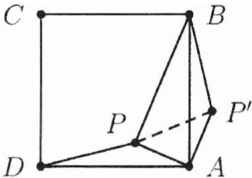
A square ABCD contains a point P such that ∣PA∣=3,∣PB∣=7and∣PD∣=5. Find the area of the square.
Solution
Proceed as in the hint and let P′ denote the rotated position of P. Thus ∣AP′∣=3, ∣BP′∣=5 and ∠PAP′=90∘. Since PAP′ is an isosceles right triangle with ∣AP′∣=∣AP∣=3, then ∣PP′∣=32.
The area of the triangle PBP′ is, by Heron's formula, given by (232+12)(232−2)(232+2)(212−32)=221 But the area of the triangle PBP′ is also given by 21∣PB∣∣PP′∣sin∠BPP′, which is equal to 2212sin∠BPP′ and so 21=sin∠BPP′. This gives ∠BPP′=45∘, and so ∠APB=90∘. From the right triangle APB we get ∣AB∣2=58. Thus the area of the square is 58.
Want a route through all this instead of an archive? The track
puts 2,604 problems in a working order, from Junior Challenge level to the IMO shortlist.
Source: MathNet,
licensed CC-BY-4.0.
Statement reproduced verbatim; metadata (topic, difficulty) added by this project.