There are five keys that assigned to lamps of a room. Each key is connected to one or more lamps and by switching a key, all lamps which is connected to that key will be switched. The set of connected lamps to each key is distinct with another. If all lamps are turned off at the beginning, prove that there are 3 keys that by switching all of them at least two lamps will be turned on.
Iranian Mathematical Olympiad
Solution
Let denote the lamps, and denote the keys. First, it is easy to see that , because otherwise there are at most 4 subsets of lamps and it's in contradiction with the assumption of the problem. Construct a table that each row corresponds to a triple set of keys and each column corresponds to a lamp.
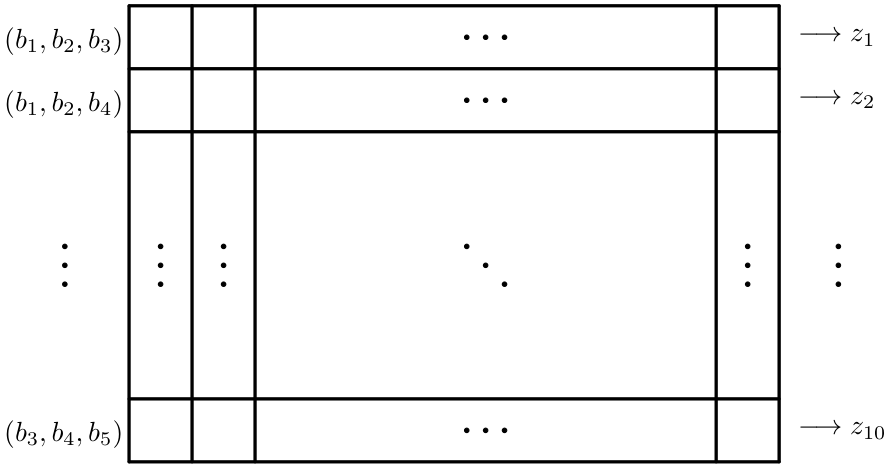
In intersection of row and column assign number 1 if after switching 3 keys corresponding to row , lamp turns on, and else assign 0. Denote the sum of row 's numbers by . Suppose lamp is connected to key . Now sum of numbers in column is , so
is positive integer between 1 and 5. It's easy to check that phrase is always greater than 3. Because of equation 1, it is deduced that
Because of pigeonhole principle there exist so that and we're done. ■
Want a route through all this instead of an archive? The track
puts 2,604 problems in a working order, from Junior Challenge level to the IMO shortlist.