Maths Olympiad Prep

Library / /17 of 18

Geometry Difficulty 7.9 National olympiad, round 2 Prove it China

Fix an equilateral triangle ABCABC with side length 11. We call (DEF,XYZ)(\triangle DEF, \triangle XYZ) a good triangle pair if the points DD, EE, and FF lie in the interior of segments BCBC, CACA, and ABAB, respectively, the points XX, YY, and ZZ lie on the lines BCBC, CACA, and ABAB, respectively, and they satisfy the conditions
DE20=EF22=FD38,andDEXY,EFYZ,FDZX. \frac{DE}{20} = \frac{EF}{22} = \frac{FD}{38}, \quad \text{and} \quad DE \perp XY, EF \perp YZ, FD \perp ZX.
As (DEF,XYZ)(\triangle DEF, \triangle XYZ) runs through all good triangle pairs, determine all possible values of 1SDEF+1SXYZ\frac{1}{S_{\triangle DEF}} + \frac{1}{S_{\triangle XYZ}}.

Solution

(1) First, consider the rotation of 9090^\circ (clockwise or counterclockwise), centered at an arbitrary point on the plane. Then the images XX', YY', and ZZ' of the points XX, YY, and ZZ, respectively, satisfy
XYDE,YZEF,ZXFD. X'Y' \parallel DE, \quad Y'Z' \parallel EF, \quad Z'X' \parallel FD.
In this case, XYZ\triangle X'Y'Z' and DEF\triangle DEF are directly similar. So, every good triangle pair is directly similar.
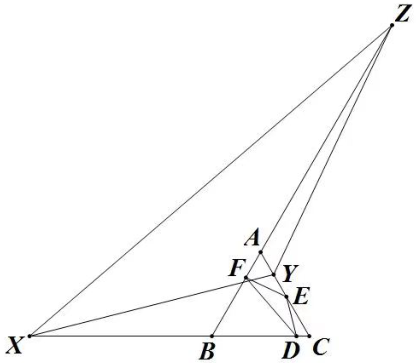
Figure 1

(2) **Rotate XYZ\triangle XYZ (together with the equilateral triangle ABCABC) 9090^\circ, and properly rescale and translate the picture so that the image of XYZ\triangle XYZ coincides with DEF\triangle DEF. Under this transformation, the points AA, BB, and CC are mapped to points A1A_1, B1B_1, and C1C_1. So there are three points A1A_1, B1B_1, and C1C_1 on the plane satisfying:**
* A1B1C1\triangle A_1B_1C_1 is an equilateral triangle;
* the points DD, EE, and FF lie on the lines B1C1B_1C_1, C1A1C_1A_1, and A1B1A_1B_1; and
* A1B1ABA_1B_1 \perp AB, B1C1BCB_1C_1 \perp BC, and C1A1CAC_1A_1 \perp CA.
From this, we see that the points A1A_1, B1B_1, and C1C_1 lie on the circumcircles of AEF\triangle AEF, BFD\triangle BFD, and CDE\triangle CDE, respectively. Moreover, A1A_1, B1B_1, and C1C_1 are the antipodes of AA, BB, and CC in the corresponding circles; see the picture below.
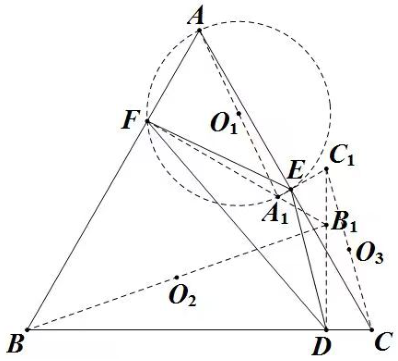
Figure 2

(3) Note that SABC:SXYZ=SA1B1C1:SDEFS_{\triangle ABC} : S_{\triangle XYZ} = S_{\triangle A_1B_1C_1} : S_{\triangle DEF}. So it suffices to compute the ratio of SABC+SA1B1C1S_{\triangle ABC} + S_{\triangle A_1B_1C_1} to SDEFS_{\triangle DEF}. We have
SABC=SDEF+SEAF+SFBD+SDCE,SA1B1C1=SDEF+SEA1F+SFB1D+SDC1E, S_{\triangle ABC} = S_{\triangle DEF} + S_{\triangle EAF} + S_{\triangle FBD} + S_{\triangle DCE}, \\ S_{\triangle A_1B_1C_1} = S_{\triangle DEF} + S_{\triangle EA_1F} + S_{\triangle FB_1D} + S_{\triangle DC_1E},
Here the right hand sides are expressed in terms of oriented areas. Since the two equilateral triangles on the left hand side are directly similar, the signs on the areas are the same. Using the properties of antipodes, if we denote the circumcenters of AEF\triangle AEF, BFD\triangle BFD, and CDE\triangle CDE by O1O_1, O2O_2, and O3O_3, respectively, then the condition "DD, EE, and FF lie on the interior of three sides" ensures that the three circumcenters O1O_1, O2O_2, and O3O_3 lie outside of DEF\triangle DEF. So we have the following equality of areas:
SABC+SA1B1C1=2(SDEF+SEO1F+SFO2D+SDO3E). S_{\triangle ABC} + S_{\triangle A_1B_1C_1} = 2(S_{\triangle DEF} + S_{\triangle EO_1F} + S_{\triangle FO_2D} + S_{\triangle DO_3E}).
In fact, O1O2O3\triangle O_1O_2O_3 is the outer Napoleon triangle of DEF\triangle DEF; its area is exactly the half of sum of the areas in the parentheses.

(4) So we need to compute, for a triangle with side length ratio 20:22:3820 : 22 : 38, the ratio of the area of the hexagon formed by the vertices of the triangle and the vertices of the outer Napoleon triangle, to the area of the original triangle.
By Heron formula, the area of a triangle with side lengths 2020, 2222, 3838 is
40(4020)(4022)(4038)=1202. \sqrt{40 \cdot (40 - 20) \cdot (40 - 22) \cdot (40 - 38)} = 120\sqrt{2}.
On the other hand,
SEO1F+SFO2D+SDO3E=33(112+102+192)=1943. S_{\triangle EO_1F} + S_{\triangle FO_2D} + S_{\triangle DO_3E} = \frac{\sqrt{3}}{3} \cdot (11^2 + 10^2 + 19^2) = 194\sqrt{3}.
So
1SDEF+1SXYZ=1SABC(SABCSDEF+SABCSXYZ)=1SABCSABC+SA1B1C1SDEF=432(1202+1943)1202=972+40315 \begin{align*} & \frac{1}{S_{\triangle DEF}} + \frac{1}{S_{\triangle XYZ}} \\ = & \frac{1}{S_{\triangle ABC}} \left( \frac{S_{\triangle ABC}}{S_{\triangle DEF}} + \frac{S_{\triangle ABC}}{S_{\triangle XYZ}} \right) \\ = & \frac{1}{S_{\triangle ABC}} \frac{S_{\triangle ABC} + S_{\triangle A_1B_1C_1}}{S_{\triangle DEF}} \\ = & \frac{4}{\sqrt{3}} \frac{2(120\sqrt{2} + 194\sqrt{3})}{120\sqrt{2}} \\ = & \frac{97\sqrt{2} + 40\sqrt{3}}{15} \end{align*}

Want a route through all this instead of an archive? The track puts 2,000 problems in a working order, from AMC 10 level to the IMO shortlist.

Source: MathNet, licensed CC-BY-4.0. Statement and solution reproduced as published; topic and difficulty added by this site.