Maths Olympiad Prep

Library / /25 of 92

Geometry Difficulty 6.1 National olympiad Prove it Iran

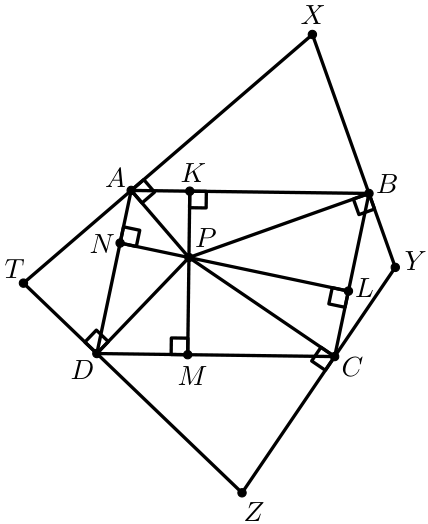
Point PP lies inside of parallelogram ABCDABCD. Perpendicular lines to PA,PB,PCPA, PB, PC and PDPD through A,B,CA, B, C and DD construct convex quadrilateral XYZTXYZT. Prove that the area of XYZTXYZT is not less than twice the area of ABCDABCD.

Solution

At first we shall prove following lemma:
Lemma. If point AA' is antipode of vertex AA in circumcircle of triangle ABCABC, then
SABCSABC=12BC2cotA, S_{ABC} - S_{A'BC} = \frac{1}{2} |BC|^2 \cot \angle A,
where SXYZS_{XYZ} denotes the area of triangle XYZXYZ.
Proof. Let HH be the orthocenter of triangle ABCABC. Notice that
SABCSABC=SABCSHBC=12BCAH=12BC2cotA. S_{ABC} - S_{A'BC} = S_{ABC} - S_{HBC} = \frac{1}{2} BC \cdot AH = \frac{1}{2} |BC|^2 \cot \angle A.
Figure 1
Figure 2

Now let AB=aAB = a, AD=bAD = b, APB=P1\angle APB = \angle P_1, BPC=P2\angle BPC = \angle P_2, CPD=P3\angle CPD = \angle P_3 and DPA=P4\angle DPA = \angle P_4. From the lemma, it's easy to see that
2SABCDSXYZT=a22(cotP1+cotP3)+b22(cotP2+cotP4)=a22(sin(P1+P3)sinP1sinP3)+b22(sin(P2+P4)sinP2sinP4) 2S_{ABCD} - S_{XYZT} = \frac{a^2}{2} (\cot \angle P_1 + \cot \angle P_3) + \frac{b^2}{2} (\cot \angle P_2 + \cot \angle P_4) \\ = \frac{a^2}{2} \left( \frac{\sin (\angle P_1 + \angle P_3)}{\sin \angle P_1 \cdot \sin \angle P_3} \right) + \frac{b^2}{2} \left( \frac{\sin (\angle P_2 + \angle P_4)}{\sin \angle P_2 \cdot \sin \angle P_4} \right)
Without loss of generality, we can assume P1+P3>180\angle P_1 + \angle P_3 > 180^\circ (If P1+P3=180\angle P_1 + \angle P_3 = 180^\circ we are done) so sin(P1+P3)<0\sin(\angle P_1 + \angle P_3) < 0. Let points K,L,MK, L, M and NN be the foot of the perpendicular lines from PP to AB,BC,CDAB, BC, CD and DADA, respectively. We need to prove that
a22(sin(P1+P3)sinP1sinP3)+b22(sin(P2+P4)sinP2sinP4)<0 \Leftrightarrow \frac{a^2}{2} \left( \frac{\sin (\angle P_1 + \angle P_3)}{\sin \angle P_1 \cdot \sin \angle P_3} \right) + \frac{b^2}{2} \left( \frac{\sin (\angle P_2 + \angle P_4)}{\sin \angle P_2 \cdot \sin \angle P_4} \right) < 0
a2sinP1sinP3>b2sinP2sinP4 \Leftrightarrow \frac{a^2}{\sin \angle P_1 \cdot \sin \angle P_3} > \frac{b^2}{\sin \angle P_2 \cdot \sin \angle P_4}
APsinABPCPsinCDP>APsinADPCPsinCBP \Leftrightarrow \frac{AP}{\sin \angle ABP} \cdot \frac{CP}{\sin \angle CDP} > \frac{AP}{\sin \angle ADP} \cdot \frac{CP}{\sin \angle CBP}

sin\Leftrightarrow \sin \angle CBP sin\cdot \sin \angle ADP > sin\sin \angle ABP sin\cdot \sin \angle CDP

BPsinCBPDPsinADP>BPsinABPDPsinCDP \Leftrightarrow BP \cdot \sin \angle CBP \cdot DP \cdot \sin \angle ADP > BP \cdot \sin \angle ABP \cdot DP \cdot \sin \angle CDP
PLPN>PKPM \Leftrightarrow PL \cdot PN > PK \cdot PM
LKN+LMN>KLM+KNM \Leftrightarrow \angle LKN + \angle LMN > \angle KLM + \angle KNM
APB+CPD>APD+BPC \Leftrightarrow \angle APB + \angle CPD > \angle APD + \angle BPC
The latest assertion is true, so the proof is completed. ■

Want a route through all this instead of an archive? The track puts 2,000 problems in a working order, from AMC 10 level to the IMO shortlist.

Source: MathNet, licensed CC-BY-4.0. Statement and solution reproduced as published; topic and difficulty added by this site.