Maths Olympiad Prep

Library / /31 of 39

Geometry Difficulty 6.5 National olympiad Prove it Romania

From a point OO inside the square ABCDABCD the perpendicular line OSOS is raised to the plane of the square. Let M,N,P,QM, N, P, Q be projections of point OO onto the planes (SAB),(SBC),(SCD)(SAB), (SBC), (SCD), respectively (SDA)(SDA). Prove that the points M,N,P,QM, N, P, Q are coplanar if and only if OO lies on one of the diagonals of the square.

Florin Bojor

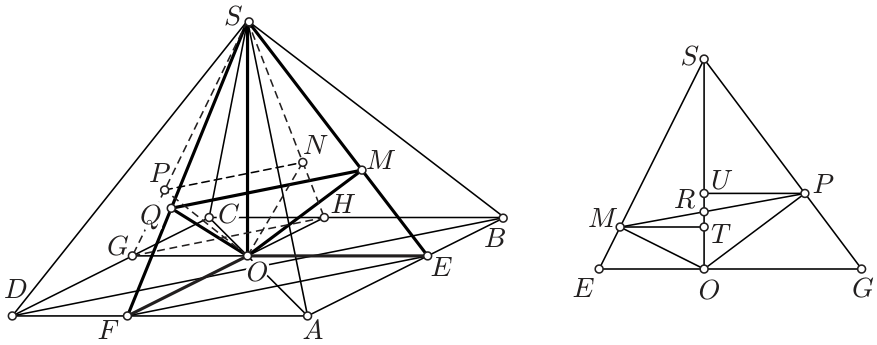
Figure 1

Solution

We assume that OO lies, for example, on the diagonal ACAC. Let OEABOE \perp AB, EABE \in AB and OFADOF \perp AD, FADF \in AD. Then we have successively OE=OFOE = OF, SOESOF\triangle SOE \equiv \triangle SOF (C.C.), SE=SFSE = SF. Then MSEM \in SE and OMSFOM \perp SF, QSFQ \in SF and OQSFOQ \perp SF, SOMSOQ\triangle SOM \equiv \triangle SOQ, SM=SQSM = SQ, SMSE=SQSF\frac{SM}{SE} = \frac{SQ}{SF}, QMEFQM \parallel EF, so QMBDQM \parallel BD. Analogously we get NPBDNP \parallel BD, so QMNPQM \parallel NP, which means that points M,N,P,QM, N, P, Q are coplanar.

Conversely, assume that M,N,P,QM, N, P, Q are coplanar in a plane α\alpha. Take OGCDOG \perp CD, GCDG \in CD and OHBCOH \perp BC, HBCH \in BC. Then the points E,O,GE, O, G are collinear, so the lines SE,SO,SGSE, SO, SG are coplanar. It follows from this that the lines SOSO and MPMP are coplanar, and SOMPSO \cap MP is the same as SOαSO \cap \alpha. Similarly we'll get NQSONQ \cap SO is the same as SOαSO \cap \alpha, so the lines MPMP and NQNQ intersect SOSO at the same point RR.

Figure 1

We calculate the ratio in which point RR divides OSOS, in terms of OS,OEOS, OE and OGOG.
Take MTOSMT \perp OS, PUOSPU \perp OS, U,TOSU, T \in OS. From the cyclic quadrilateral MOPSMOPS we get MSROPR\triangle MSR \sim \triangle OPR, so MSOP=MROR=SRPR\frac{MS}{OP} = \frac{MR}{OR} = \frac{SR}{PR}, hence MS2OP2=SRORMRPR=SRORMTPU\frac{MS^2}{OP^2} = \frac{SR}{OR} \cdot \frac{MR}{PR} = \frac{SR}{OR} \cdot \frac{MT}{PU}. It follows SROR=PUMTMS2OP2=PSPOMS2MOMSPSPG=POPGMSMO\frac{SR}{OR} = \frac{PU}{MT} \cdot \frac{MS^2}{OP^2} = \frac{PS \cdot PO \cdot MS^2}{MO \cdot MS \cdot PS \cdot PG} = \frac{PO}{PG} \cdot \frac{MS}{MO}. But POPG=tanSGO=SOOG\frac{PO}{PG} = \tan \angle SGO = \frac{SO}{OG} and MSMO=cotMSO=SOOE\frac{MS}{MO} = \cot \angle MSO = \frac{SO}{OE}, so SROR=SO2OEOG\frac{SR}{OR} = \frac{SO^2}{OE \cdot OG}.

Since line NQNQ intersects OSOS also in RR, we obtain OEOG=OFOHOE \cdot OG = OF \cdot OH. On the other hand we have OE+OG=l=OF+OHOE + OG = l = OF + OH, where l=AB=ADl = AB = AD. It follows from this that OE(lOE)=OF(lOF)OE(l - OE) = OF(l - OF), then (OEOF)(lOEOF)=0(OE - OF)(l - OE - OF) = 0, so (OEOF)(OHOE)=0(OE - OF)(OH - OE) = 0. Thus OE=OFOE = OF or OE=OHOE = OH, which implies OACO \in AC or OBDO \in BD.

Want a route through all this instead of an archive? The track puts 2,000 problems in a working order, from AMC 10 level to the IMO shortlist.

Source: MathNet, licensed CC-BY-4.0. Statement and solution reproduced as published; topic and difficulty added by this site.