The squares of an board are labeled from to so that the squares labeled and always have a side in common. Show that for some the squares and have a side in common.
Brazilian Mathematical Olympiad
Solution
Consider the center of the unit squares and connect two centers if the numbers assigned to the correspondent squares are consecutive. Then we obtain a path with unit segments. The centers determine a lattice with unit squares. Squares with numbers and correspond to a lattice square with three unit segments:
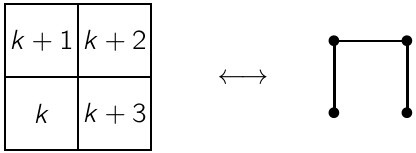
So we need to prove that there is a lattice square with at least segments. Suppose the contrary, so the number of segments is at most , in which border segments are counted once and the interior segments are counted twice. The path uses at most segments on the border. So there are at least interior segments. Hence the path uses lattice segments (counting repetitions), a contradiction.
Want a route through all this instead of an archive? The track
puts 2,604 problems in a working order, from Junior Challenge level to the IMO shortlist.