GeometryDifficulty 6.0National olympiadFind the answerUnited States
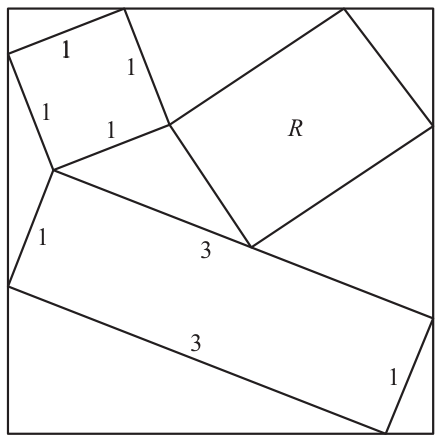
A rectangle with side lengths 1 and 3, a square with side length 1, and a rectangle R are inscribed inside a larger square as shown. The sum of all possible values for the area of R can be written in the form nm, where m and n are relatively prime positive integers. What is m+n?
Pick one
Solution
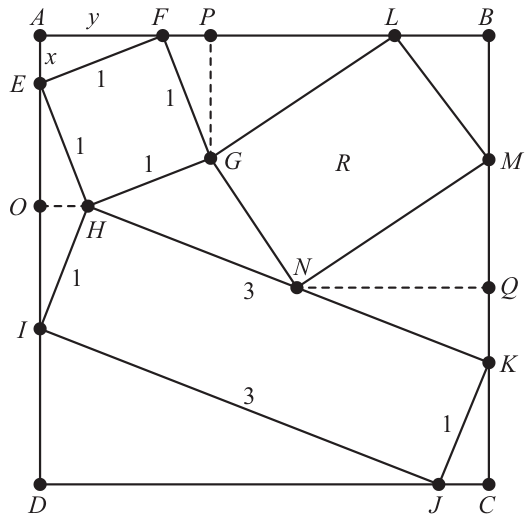
Label the diagram as shown below, where O, P, and Q are the feet of the perpendicular segments to the respective sides. Let x=AE and y=AF.
Because △FAE≅△EOH≅△IOH≅△KCJ≅△FPG, it follows that EO=IO=KC=y and CJ=AE=x. Furthermore, △JDI is similar to all these triangles with scale factor 3, so ID=3x and DJ=3y. Therefore 3y+x=DC=DA=2y+4x, so y=3x. Applying the Pythagorean Theorem to △AEF yields x=101.
Now set PL=ax and LB=bx for some positive real numbers a and b. Note that MQ=PG=y=3x, and because △GPL∼△LBM, it follows that BM=31abx. Furthermore, △NQK∼△KCJ, and because NQ=PL=ax, it follows that QK=31ax. Therefore 3x+31ax+3x+31abx=BC=AD=10x, which simplifies to a(b+1)=12. Because PB=AB−AP=6x, it follows that a+b=6. Solving these equations simultaneously for a and b shows that (a,b) equals either (3,3) or (4,2).
Finally, observe that the area of R is LG⋅LM=(ax)2+(3x)2⋅(bx)2+(31abx)2=(a2+9)x2⋅(b2+91a2b2)x2=x2a2+9⋅b2+91a2b2=x2a2+9⋅b2(1+91a2)=x2a2+9⋅b1+91a2=x2b(a2+9)(1+91a2). Since x=101, x2=101, so the area is 10b(a2+9)(1+91a2). When (a,b)=(3,3), this area equals 59; and when (a,b)=(4,2), this area equals 35. The sum of these two areas is 59+35=1527+1525=1552, and the requested sum of numerator and denominator is 52+15=67.
Want a route through all this instead of an archive? The track
puts 2,000 problems in a working order, from AMC 10 level to the IMO shortlist.
Source: MathNet,
licensed CC-BY-4.0.
Statement and solution reproduced as published; topic and difficulty added by this site.