Each of the sides and the diagonals of a regular pentagon are randomly and independently colored red or blue with equal probability. What is the probability that there will be a triangle whose vertices are among the vertices of the pentagon such that all of its sides have the same color?
Fall AMC 10 B, 2021
Solution
It will be easier to compute the probability that no monochromatic triangles exist. Suppose one of the vertices, say , has segments of the same color connecting it to other vertices, say , , and . If one of the edges of has the same color as edges , , and , then a monochromatic triangle exists. Otherwise, forms a monochromatic triangle of the other color. Therefore in order for there to be no monochromatic triangles, each vertex must be incident to exactly red and blue segments. This is possible only if the coloring creates a loop of segments all colored red and a loop of segments all colored blue.
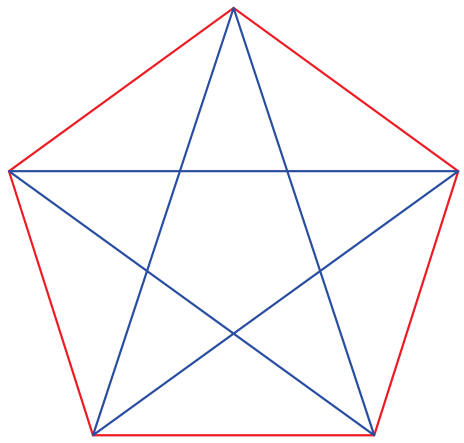
There are choices for the red loop because the loop can always be viewed as starting at a particular vertex and can go in two different directions. There are different colorings of the segments. Therefore the requested probability is
Want a route through all this instead of an archive? The track
puts 2,604 problems in a working order, from Junior Challenge level to the IMO shortlist.