(Solution by A. Goloubitskaya.) Let Γ be the circumcircle of the given regular hexagon. It is evident that B is the center of Γ. Since all sides of the regular hexagon are equal, we have 2α=arc A1A2=arc A2A3=⋯=arc A9A10=arc A10A1=36∘. Since A1A2=A9A10, ∠A10A2A1=∠A1A9A10=α and ∠A2A1A9=∠A2A10A9=7α, it follows that the triangles A1A2C and A10A9C are equal, so CA1=CA10. Hence the line BC is the bisector of the segment A1A10. Then the line BC contains the altitude, the median, and the bisectrix of the isosceles triangle A10BA1 (BA10=BA1). Hence, ∠A1BC=0.5 arc A10A1=α=18∘. Similarly, ∠A2BA=0.5 arc A2BA4=0.5 arc A2A4=2α=36∘. Since ∠A2BA1=2α=72∘, we have
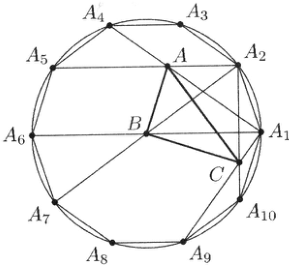
∠ABC=∠ABA2+∠A2BA1+∠A1BC=36∘+36∘+18∘=90∘.
Since ∠AA2C=∠A5A2A10=5α=90∘, we have ∠ABC+∠AA2C=180∘, so the points A, B, C, A2 are concyclic. Then ∠BCA=∠BA2A=2α=36∘ and ∠CAB=180∘−∠ABC−∠BCA=54∘.