Maths Olympiad Prep

Library / /3 of 15

, 2021

Geometry Difficulty 4.3 AIME Find the answer United States

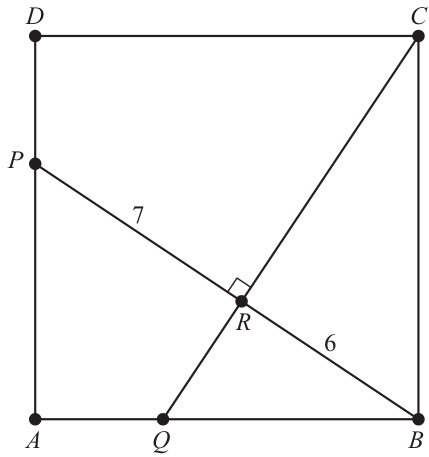
In square ABCDABCD, points PP and QQ lie on AD\overline{AD} and AB\overline{AB}, respectively. Segments BP\overline{BP} and CQ\overline{CQ} intersect at right angles at RR, with BR=6BR = 6 and PR=7PR = 7. What is the area of the square?

Figure 1

Pick one

Solution

Because RBC\angle RBC is complementary to both RCB\angle RCB and PBA\angle PBA, those two angles are congruent. Therefore BAPCBQ\triangle BAP \cong \triangle CBQ by ASA, so CQ=BP=13CQ = BP = 13. Let d=CRd = CR; then QR=13dQR = 13 - d, so the Altitude-to-Hypotenuse Theorem yields 62=d(13d)6^2 = d(13 - d), which has solutions d=4d = 4 and d=9d = 9. Because QR<RCQR < RC, in fact d=9d = 9. It follows that the area of the square is
BC2=BR2+RC2=62+92=117. BC^2 = BR^2 + RC^2 = 6^2 + 9^2 = 117.

Let c=BQc = BQ and s=ABs = AB. Because BRQ\triangle BRQ is similar to BAP\triangle BAP, it follows that 6c=s13\frac{6}{c} = \frac{s}{13}, so cs=78cs = 78. As before, CQ=BP=13CQ = BP = 13, so by the Pythagorean Theorem, s2+c2=169s^2 + c^2 = 169. Then (s+c)2=169+278=325(s+c)^2 = 169 + 2 \cdot 78 = 325, so s+c=513s + c = 5\sqrt{13}. Similarly (sc)2=169278=13(s-c)^2 = 169 - 2 \cdot 78 = 13, so sc=13s - c = \sqrt{13}. Solving this system of equations yields s=313s = 3\sqrt{13}, and the area of the square is s2=117s^2 = 117.

Want a route through all this instead of an archive? The track puts 2,000 problems in a working order, from AMC 10 level to the IMO shortlist.

Source: MathNet, licensed CC-BY-4.0. Statement and solution reproduced as published; topic and difficulty added by this site.