Consider an acute-angled triangle and its circumcircle. Let be a point on the arc which does not include point and let and be points on the lines and , respectively, such that and . Prove that .
Selected Problems from Open Contests
Solution
If is the diameter of the circumcircle of triangle , then and and the statement holds. Assume that is not the diameter (Fig. 3). Then and . The point lies on the ray if and only if the point does not lie on the ray (depending on which side of the diameter through point point is located). Thus,
(because the sum of opposite angles of a cyclic quadrilateral is ). Thus, the right-angled triangles and are similar. From we see that . This together with gives that and are similar. As , we conclude that .
Solution 2:
Since the angles and are right angles, the points , and form a cyclic quadrilateral and thus . Similarly, . Therefore the triangles and are similar. As , we deduce that .
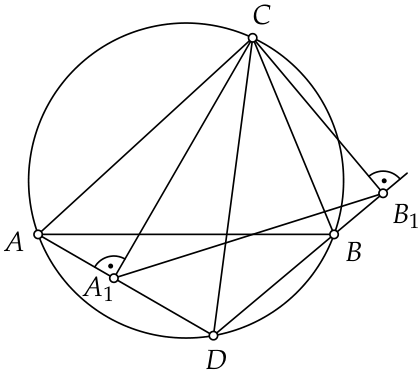
Fig. 3
Solution 3:
The radius of the circumcircle of the quadrilateral is at least as large as the radius of the circumcircle of the quadrilateral because is a chord in the first one and a diameter in the second one. The sine law in triangles and gives and . As , we deduce .
Want a route through all this instead of an archive? The track
puts 2,604 problems in a working order, from Junior Challenge level to the IMO shortlist.