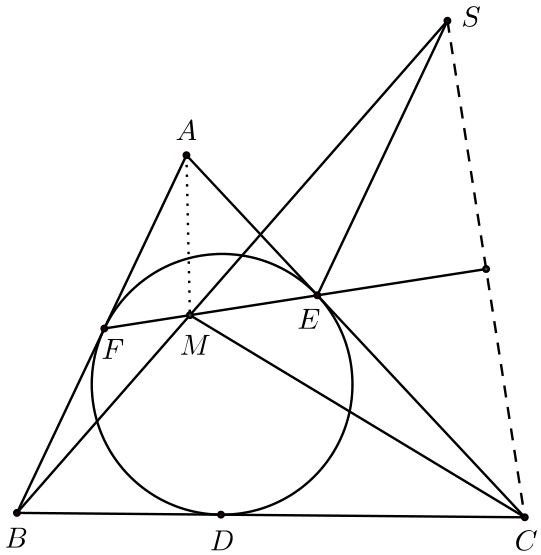
The incircle of triangle ABC touches the sides BC, CA, and AB at D, E, and F respectively. On the line segments EF, FD, and DE, consider the points M, N, and P respectively such that the sums BM+MC, CN+NA, and AP+PB are minimum.
a) Prove that the lines AM, BN, and CP are concurrent.
b) Prove that DM, EN and FP are the altitudes of triangle DEF.
Solution
a) Let S be the reflection of C across the line EF. As AE=AF, it follows that ∠AFE=∠AEF, hence ∠BFE=∠FEC=∠FES, therefore FB and ES are parallel. FBES is a trapezoid (or a parallelogram); let M be the intersection point of its diagonals. According to the billiards problem, M is the point of the line EF for which the sum BM+MC is minimum. Triangles BFM and SEM are similar, therefore EMFM=ESFB=ECFB=s−cs−b. It follows that sin(EAM)sin(FAM)=[EAM][FAM]=EMFM=s−cs−b. Multiplying this with the two analogous relations we get sin(EAM)sin(FAM)⋅sin(DCP)sin(ECP)⋅sin(NBF)sin(DBN)=1. By the converse of the trigonometric form of Ceva's theorem, it follows that the lines AM, BN, and CP are concurrent.
b) We have EMFM=p−cp−b=CDBD=CEBF, hence, from a well-known problem ("The gliding bisector Theorem") it follows that DM is parallel to the bisector of angle ∠BAC. The bisector is perpendicular to EF, therefore DM is also perpendicular to EF.
Want a route through all this instead of an archive? The track
puts 2,604 problems in a working order, from Junior Challenge level to the IMO shortlist.
Source: MathNet,
licensed CC-BY-4.0.
Statement reproduced verbatim; metadata (topic, difficulty) added by this project.