Maths Olympiad Prep

Library / /10 of 20

Algebra Difficulty 5.9 AIME, harder Prove it Greece

The positive real numbers aa, bb, cc satisfy: a2+b2+c2=3a^2 + b^2 + c^2 = 3. Prove that

a2+b22ab+b2+c22bc+c2+a22ca+2(ab+bc+ca)35. \frac{a^2 + b^2}{2ab} + \frac{b^2 + c^2}{2bc} + \frac{c^2 + a^2}{2ca} + \frac{2(ab + bc + ca)}{3} \geq 5.
When does equality hold?

Solution

BA^C=BD^C=DB^C=DA^C. B\hat{A}C = B\hat{D}C = D\hat{B}C = D\hat{A}C.
Hence ACAC is the bisector of the angle BA^DB\hat{A}D, and hence it is the perpendicular bisector of the base BEBE od the isosceles BAE\triangle BAE.
Now we can complete the proof in two ways:
First way: Since the points E,B,FE, B, F belong to the circle with center AA and radius ABAB, by using the relation between subtending angles and the angle formed by chord and tangent, we have the wanted result:
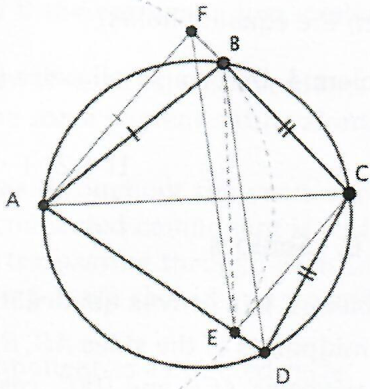
EF^B=EA^B2=EA^C=DA^C=DB^C E\hat{F}B = \frac{E\hat{A}B}{2} = E\hat{A}C = D\hat{A}C = D\hat{B}C

Figure 1
Figure 7

Second way: We have CE=CB=CDCE = CB = CD, as well as, CE^D=CD^EC\hat{E}D = C\hat{D}E.
From the cyclic quadrilateral ABCDABCD and the isosceles triangle FABFAB we get:
AF^B=AB^F=AD^C=CE^D=180AE^CA\hat{F}B = A\hat{B}F = A\hat{D}C = C\hat{E}D = 180^\circ - A\hat{E}C, and therefore the quadrilateral AFCEAFCE is cyclic. Thus we have;
EF^B=EF^C=EA^C=DA^C=DB^C. E\hat{F}B = E\hat{F}C = E\hat{A}C = D\hat{A}C = D\hat{B}C.

Want a route through all this instead of an archive? The track puts 2,000 problems in a working order, from AMC 10 level to the IMO shortlist.

Source: MathNet, licensed CC-BY-4.0. Statement and solution reproduced as published; topic and difficulty added by this site.