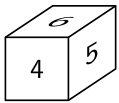
There are 8 identical dice. The numbers 4, 5, 6 are written on three faces of the dice, as shown in the figure, and the remaining faces carry the numbers 1, 2, 3 so that the sum of the numbers written on each pair of opposite faces is 7.
a) Show that using these dice, it is possible to form a 2×2×2 cube so that every two faces that touch each other carry the same number.
b) Is it possible to do this in such a way that only numbers 4, 5, 6 occur on the outer surface of the resulting cube?
Solution
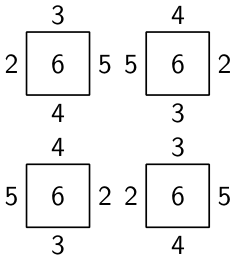
a) Put together four dice as depicted in Fig. 7. These dice form the lower layer of the cube. On top of this, place another similar layer turned upside down. By the construction of the layer, the numbers on the faces touching each other within one layer coincide everywhere. As the second layer is turned upside down, the numbers on faces of cubes of different layers that touch each other also coincide.
Fig. 7
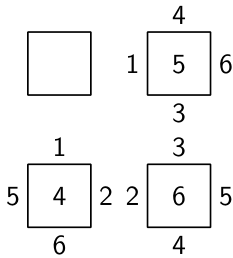
b) Suppose it is possible to form a 2×2×2 cube so that its surface contains only numbers 4, 5, 6. As exactly 3 faces of each unit cube are visible, all three numbers must occur on those. Place the cube in such a way that the upper layer has 6 in its southeastern corner (see Fig. 8). Then, as the only possibility, the upper layer must have 4 in its southwestern corner and 5 in its northeastern corner. Now it is impossible to place a die in the north-western corner since it should touch both of its neighbors with number 1.
Fig. 8
Want a route through all this instead of an archive? The track
puts 2,604 problems in a working order, from Junior Challenge level to the IMO shortlist.
Source: MathNet,
licensed CC-BY-4.0.
Statement reproduced verbatim; metadata (topic, difficulty) added by this project.