Maths Olympiad Prep

Library / Czech-Slovak-Polish Match /7 of 22

Czech-Slovak-Polish Match

Geometry Difficulty 5.7 AIME, harder Prove it Czech-Polish-Slovak Mathematical Match

We are given 60 arbitrary points in a unit disc. Prove that there exists a point on the boundary of the disc such that the sum of its distances from all 60 given points doesn't exceed 80.

Solution

Let us inscribe an equilateral triangle PQRPQR into the boundary unit circle. If we prove that any point XX of our unit disc satisfies
∣PX∣+∣QX∣+∣RX∣≤4,(1) |PX| + |QX| + |RX| \le 4, \quad (1)
then summing (1), with the given points X=XkX = X_k, 1≤k≤601 \le k \le 60, we get
∑k=160∣PXk∣+∑k=160∣QXk∣+∑k=160∣RXk∣≤4⋅60=240. \sum_{k=1}^{60} |PX_k| + \sum_{k=1}^{60} |QX_k| + \sum_{k=1}^{60} |RX_k| \le 4 \cdot 60 = 240.
Consequently, one of the sums in the left-hand side does not exceed 240:3=80240 : 3 = 80, hence some of the points PP, QQ, RR has always the required property.

In view of symmetry, it suffices to prove (1) if XX lies in the sector PSQPSQ, where SS denotes the centre of the disc. We are going to show that, in this case,
∣PX∣+∣QX∣≤2,(2) |PX| + |QX| \le 2, \quad (2)
which together with ∣RX∣≤2|RX| \le 2 will lead to (1).

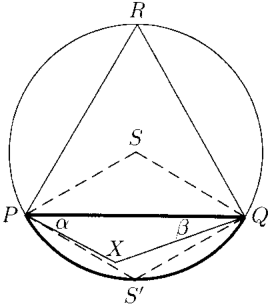
Let us denote S′S' the midpoint of the corresponding arc PQPQ (opposite to the arc PRQPRQ, Fig. 1), then clearly PS′QSPS'QS is a rhombus, hence it is sufficient to prove (2) only for points XX in the region PS′QPS'Q of the given disc (bounded by segment PQPQ and arc PS′QPS'Q).
Denoting α=∣∠XPQ∣\alpha = |\angle XPQ|, β=∣∠XQP∣\beta = |\angle XQP| we have α+β≤60∘\alpha + \beta \le 60^\circ and using the law of sines in the triangle PQXPQX we get
∣PX∣+∣QX∣=∣PQ∣(sin⁡α+sin⁡β)sin⁡(α+β)=3⋅2sin⁡α+β2cos⁡α−β22sin⁡α+β2cos⁡α+β2=3cos⁡α−β2cos⁡α+β2≤3⋅13=2,as α+β2≤30∘. \begin{aligned} |PX| + |QX| &= \frac{|PQ|(\sin \alpha + \sin \beta)}{\sin(\alpha + \beta)} = \frac{\sqrt{3} \cdot 2 \sin \frac{\alpha+\beta}{2} \cos \frac{\alpha-\beta}{2}}{2 \sin \frac{\alpha+\beta}{2} \cos \frac{\alpha+\beta}{2}} \\ &= \frac{\sqrt{3} \cos \frac{\alpha-\beta}{2}}{\cos \frac{\alpha+\beta}{2}} \le \frac{\sqrt{3} \cdot 1}{\sqrt{3}} = 2, \quad \text{as } \frac{\alpha+\beta}{2} \le 30^\circ. \end{aligned}
Thus (2) is proven.

Figure 1

Fig. 1

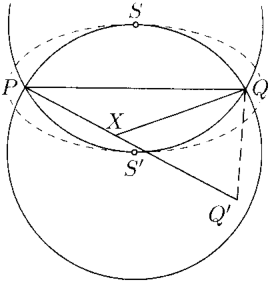
Figure 2

Fig. 2

Want a route through all this instead of an archive? The track puts 2,604 problems in a working order, from Junior Challenge level to the IMO shortlist.

Source: MathNet, licensed CC-BY-4.0. Statement reproduced verbatim; metadata (topic, difficulty) added by this project.