Maths Olympiad Prep

Library / /7 of 10

, 2011

Geometry Difficulty 5.5 AIME, harder Prove it India

Let ABCDABCD be a quadrilateral inscribed in a circle Γ\Gamma. Let EE, FF, GG, HH be the midpoints of the arcs ABAB, BCBC, CDCD, DADA of the circle Γ\Gamma. Suppose ACBD=EGFHAC \cdot BD = EG \cdot FH. Prove that ACAC, BDBD, EGEG, FHFH are concurrent.

Solution

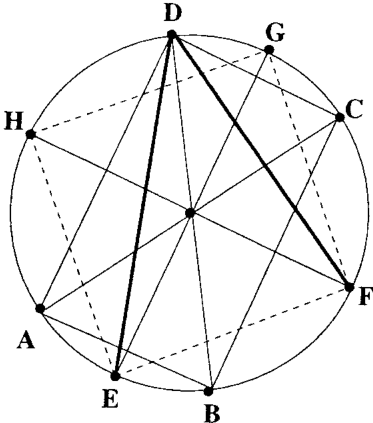
Figure 1

Let RR be the radius of the circle Γ\Gamma. Observe that EDF=12D\angle EDF = \frac{1}{2}\angle D. Hence EF=2RsinD2EF = 2R \sin \frac{D}{2}. Similarly, HG=2RsinB2HG = 2R \sin \frac{B}{2}. But B=180D\angle B = 180^\circ - \angle D.
Thus HG=2RcosD2HG = 2R \cos \frac{D}{2}. We hence get
EFGH=4R2sinD2cosD2=2R2sinD=RAC. EF \cdot GH = 4R^2 \sin \frac{D}{2} \cos \frac{D}{2} = 2R^2 \sin D = R \cdot AC.

Similarly, we obtain EHFG=RBDEH \cdot FG = R \cdot BD.

Therefore
R(AC+BD)=EFGH+EHFG=EGFH, R(AC + BD) = EF \cdot GH + EH \cdot FG = EG \cdot FH,
by Ptolemy's theorem. By the given hypothesis, this gives R(AC+BD)=ACBDR(AC + BD) = AC \cdot BD. Thus
ACBD=R(AC+BD)2RACBD, AC \cdot BD = R(AC + BD) \geq 2R\sqrt{AC \cdot BD},
using AM-GM inequality. This implies that ACBD4R2AC \cdot BD \geq 4R^2. But ACAC and BDBD are the chords of Γ\Gamma, so that AC2RAC \leq 2R and BD2RBD \leq 2R. We obtain ACBD4R2AC \cdot BD \leq 4R^2. It follows that ACBD=4R2AC \cdot BD = 4R^2, implying that AC=BD=2RAC = BD = 2R. Thus ACAC and BDBD are two diameters of Γ\Gamma. Using EGFH=ACBDEG \cdot FH = AC \cdot BD, we conclude that EGEG and FHFH are also two diameters of Γ\Gamma. Hence ACAC, BDBD, EGEG and FHFH all pass through the centre of Γ\Gamma.

Want a route through all this instead of an archive? The track puts 2,000 problems in a working order, from AMC 10 level to the IMO shortlist.

Source: MathNet, licensed CC-BY-4.0. Statement and solution reproduced as published; topic and difficulty added by this site.