Let be an acute triangle, and let be the midpoint of . A circle passing through and meets the sides and again at and , respectively. Let be the point such that the quadrilateral is a parallelogram. Suppose that lies on the circumcircle of the triangle . Determine all possible values of .
IMO Shortlist
Solutions — 3
Solution 1
Let be the center of the parallelogram , and let be the point on the ray such that (see Figure 1).
It follows that is a parallelogram. Then, and , and so the triangles and are similar. It follows that and are corresponding medians in these triangles. Hence,
Since and , the triangles and are similar. Again, as and are corresponding medians in these triangles, we have
Now we deal separately with two cases.
Case 1. does not lie on . Since the configuration is symmetric between and , we may assume that and lie on the same side with respect to the line .
Applying the previous results, we get
and so the triangles and are similar. We now have , so .
Case 2. lies on . It follows from the previous results that (see Figure 2). Thus, and . Hence, , so and .
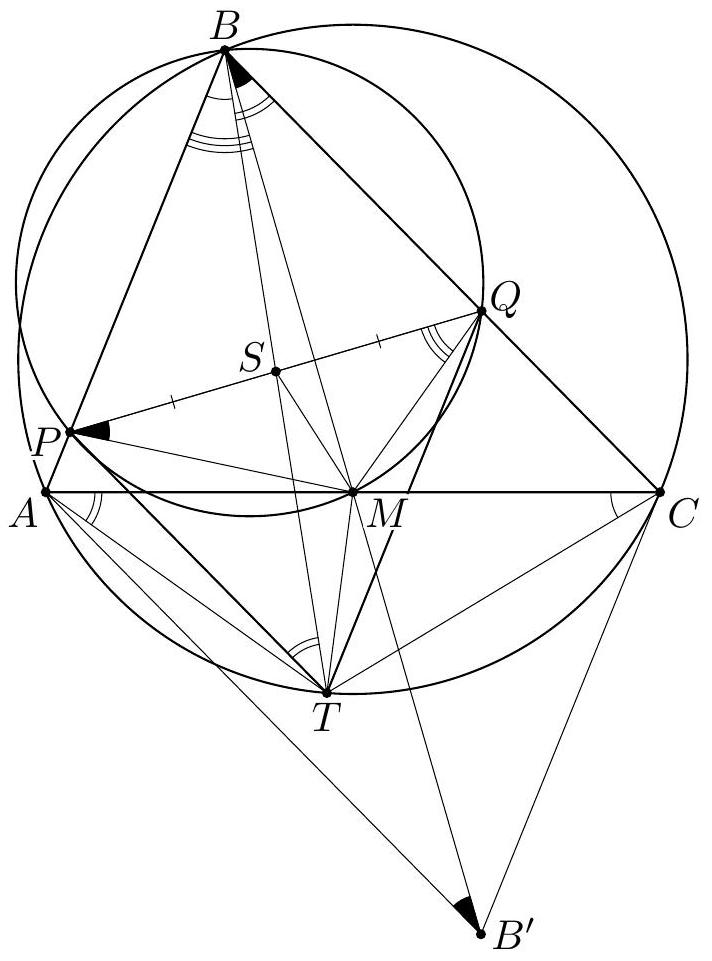
Figure 1
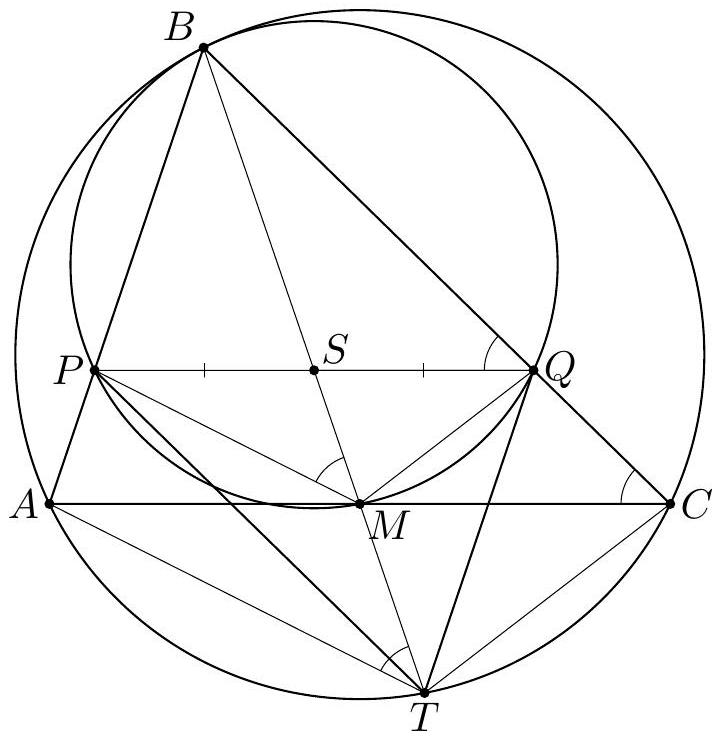
Figure 2
Solution 2
Again, we denote by the circumcircle of the triangle .
Choose the points and on the rays and respectively, so that and (see Figure 4). Then the triangles and are similar. Since , the points and correspond to each other in these triangles. So, if , then . Thus
which means that lies on the line .
Let be the point on the ray such that . Then and . This means that the triangles , , , and are all similar; hence . Thus there exists an inversion centered at which swaps with , with , and with . This inversion then swaps with the line , and hence it preserves . Therefore, we have , and .
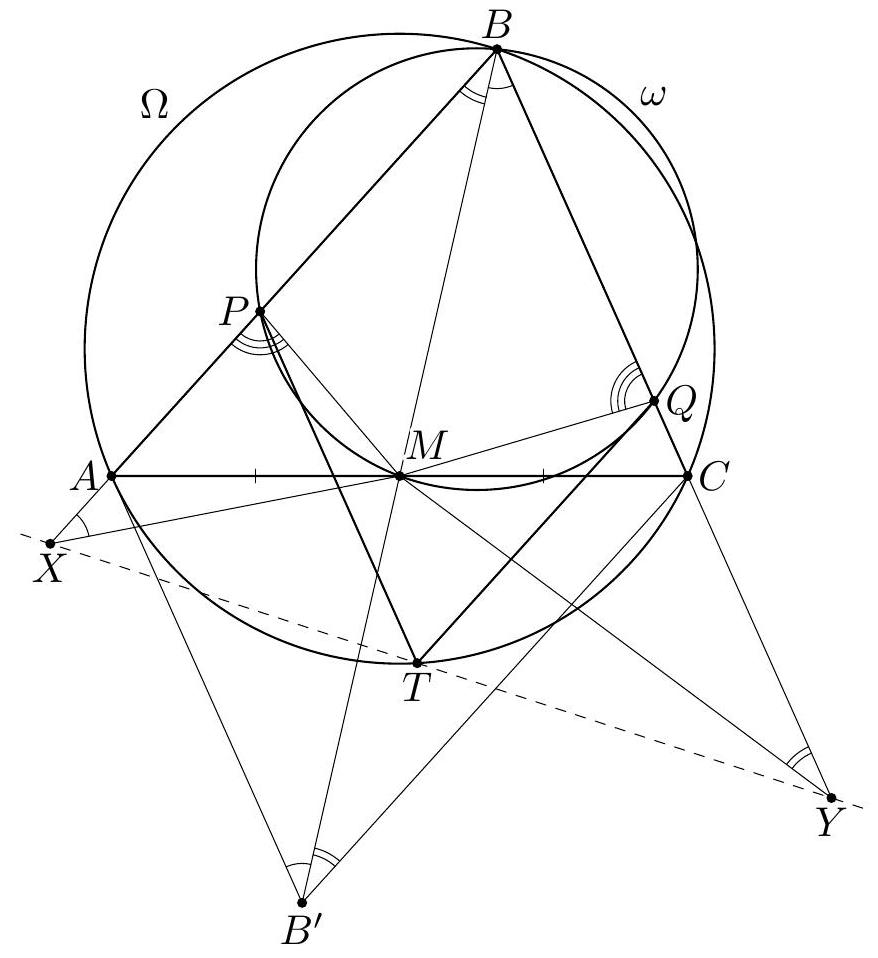
Figure 4
Solution 3
We begin with the following lemma.
Lemma. Let be a cyclic quadrilateral. Let and be points on the sides and respectively, such that is a parallelogram. Then .
Proof. Let the circumcircle of the triangle meet the line again at (see Figure 5). The power of with respect to this circle yields
We also have and , and so the triangles and are similar. We now have . Therefore,
Combining the above, we get the desired result.
Let and be the midpoints of and respectively (see Figure 6). Applying the lemma to the cyclic quadrilaterals and , we obtain
and
Since and , we have , and so .
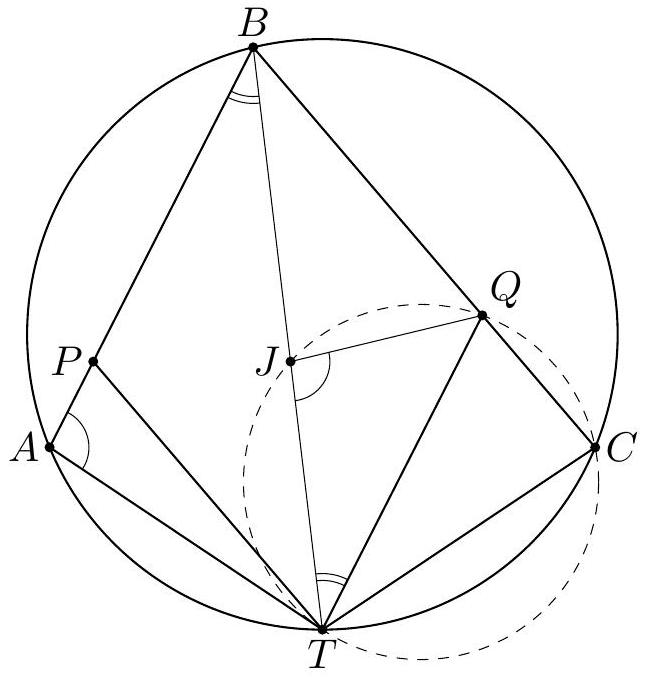
Figure 5
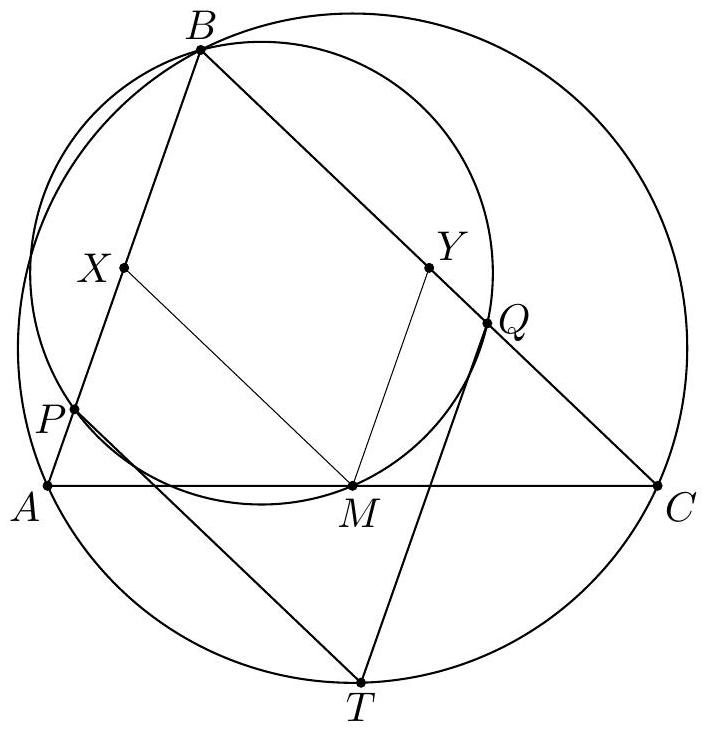
Figure 6
Want a route through all this instead of an archive? The track
puts 2,604 problems in a working order, from Junior Challenge level to the IMO shortlist.