Proof Through point L draw perpendicular lines to AB and to AC, the feet are L′ and L′′ respectively. Let ∠LAB=α1, ∠LAC=α2, ∠LF2A=α3, and ∠LE1A=α4. We have
sinα2sinα1=LL′′LL′=LE1sinα4LF2sinα3.①
Draw line segments D1F2 and D2E1 (see Figure 1). Since △LD1F2∼△LD2E1 we get
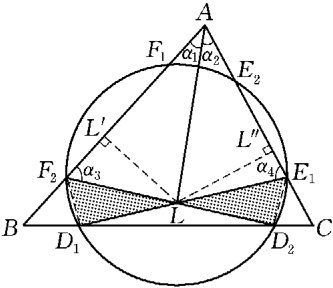
Figure 1
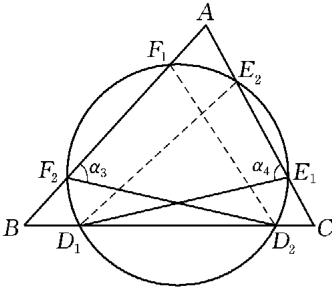
Figure 2
LE1LF2=D2E1D1F2.2◯
Draw line segments D2F1 and D1E2 (see Figure 2). By using the sine rule we obtain
sinα4sinα3=D1E2D2F1.3◯
Substituting ② and ③ into ①, we have
sinα2sinα1=D2E1D1F2⋅D1E2D2F1.4◯
Similarly, write ∠BMC=β1, ∠MBA=β2, ∠NCA=γ1, ∠NCB=γ2, and we get
sinβ2sinβ1=E2F1E1D2⋅E1F2E2D1,5◯
sinγ2sinγ1=F2D1F1E2⋅F1D2F2E1.6◯
Multiplying ④, ⑤ and ⑥, we obtain
sinα2sinα1⋅sinβ2sinβ1⋅sinγ2sinγ1=1.
Finally, according to the inverse of Ceva's Theorem, we know AL, BM and CN have a common point.