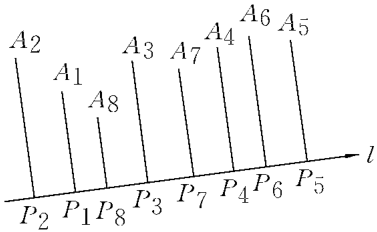
(1) For two parallel and directed lines with the same direction, the order of projections of A1,A2,…,A8 must be the same. So, we need only to discuss all directed lines passing through a fixed point O.
(2) If a directed line taken is perpendicular to a line joining two given points, then the projections of these two points must coincide, and a corresponding permutation will not be produced. When the directed lines taken are not perpendicular to any line joining two given points, any two projections of A1,A2,…,A8 must not coincide. Hence there is a corresponding permutation.
(3) Suppose that the number of lines through point O and perpendicular to a line joining two given points is k. Then k≤C82=28. Then there arise 2k directed lines placed anticlockwise. Assume that they are in order of l1,l2,…,l2k. For an arbitrary directed line l (different to l1,…,l2k), there must be two consecutive directed lines lj and lj+1 such that lj,l,lj+1 are placed anticlockwise. It is obvious that for given j, the corresponding permutations obtained from such l must be the same.
(4) For any two directed lines l and l′ different from l1,…,l2k, if we cannot find j such that both lj,l,lj+1 and lj,l′,lj+1 satisfy (3). Then there must be j so that l′,lj,l are placed anticlockwise. Assume that lj is perpendicular to the line joining Aj1 and Aj2, it is obvious that the orders of the projections of points Aj1 and Aj2 on the directed lines l and l′ must be different, so the corresponding permutations must also be different.
(5) It follows from (3) and (4) that the number of different permutations is 2k. Note that k=C82 is obtainable, so N8=56.