China Mathematical Competition (Complementary Test)
GeometryDifficulty 5.5AIME, harderProve itChina
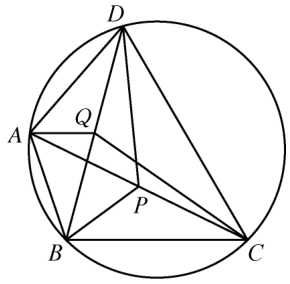
As seen in Fig. 1.1, points P, Q are, respectively, the midpoints of AC, BD — the two diagonals of cyclic quadrilateral ABCD. Let ∠BPA=∠DPA. Prove ∠AQB=∠CQB.
Solution
As shown in Fig. 1.2, we extend segment DP to intercept with the circle at point E. Then ∠CPE=∠DPA=∠BPA. Since P is the midpoint of AC, we get AB=CE, which means ∠CDP=∠BDA. Furthermore, ∠ABD=∠PCD. Therefore, △ABD∼△PCB. Then BDAB=CDPC, i.e., AB⋅CD=PC⋅BD.
Then we have AB⋅CD=21AC⋅BD=AC⋅(21BD)=AC⋅BQ, or ACAB=CDBQ. Combining it with ∠ABQ=∠ACD, we derive that △ABQ∼△ACD. So ∠QAB=∠DAC.
Extending segment AQ to intercept with the circle at point F, we then have ∠CAB=∠QAB−∠QAC=∠DAC−∠QAC=∠DAF, which means BC=DF. Furthermore, as Q is the midpoint of BD, then ∠CQB=∠DQF.
Since ∠AQB=∠DQF, we then have ∠AQB=∠CQB.
The proof is completed. □
Want a route through all this instead of an archive? The track
puts 2,604 problems in a working order, from Junior Challenge level to the IMO shortlist.
Source: MathNet,
licensed CC-BY-4.0.
Statement reproduced verbatim; metadata (topic, difficulty) added by this project.