a) Since D,E are the tangency points of (I) with BC, CA respectively, we have DE⊥CI. Moreover, FL⊥CI so DE∥FL. Similarly, we have DF∥EK.
Clearly, we have DK=DL=EF or D lies on the perpendicular bisector of KL. Furthermore, I also lies on the perpendicular bisector of KL, therefore D,I and J are collinear.
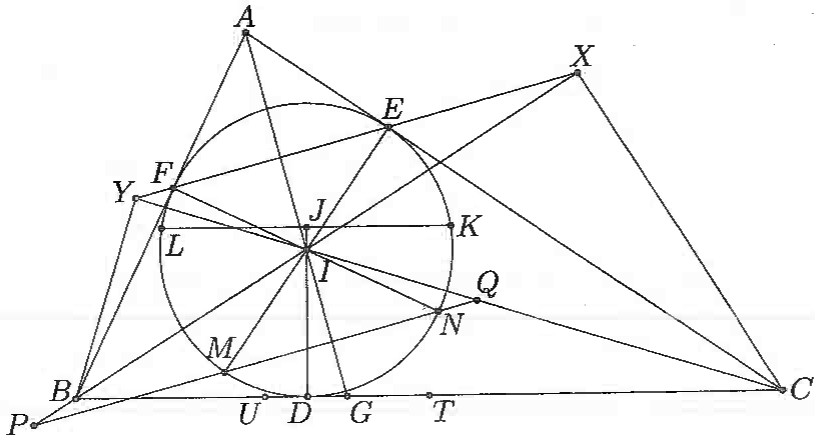
b) Let T be the midpoint of BC, G be the intersection of AI with BC and U be the reflection of T over G. We will show that the perpendicular bisector of PQ always passes through U. Let X,Y be the intersections of EF with BI and CI, respectively. We have
∠XIC=180∘−∠BIC=90∘−2∠BAC=∠AEI−∠EFI=∠AEF=∠XEC.
Hence, C,I,E and X are concyclic, which implies ∠BXC=90∘. Similarly, we obtain ∠BYC=90∘. Since ∠BXC=∠BYC=90∘, the four points B,C,X and Y lie on a circle with center T and diameter BC. It follows that T lies on the perpendicular bisector of the segment XY.
It is easy to see that the pairs of points M,E and N,F are symmetric with respect to I, so EF∥MN or XY∥PQ. From there, we have △IEX=△IMP, which implies that X and P are symmetric with respect to I. Similarly, we also have Y and Q are symmetric with respect to I. Hence two perpendicular bisectors of XY and PQ are symmetric with respect to AI. Thus, the perpendicular bisector of PQ passes through U.
Since B,C are fixed, then T is fixed. Note that GCGB=ACAB remains unchanged so G is fixed. Hence U is fixed. So the perpendicular bisector of PQ always passes through the fixed point U. □