Let be a triangle inscribed in a circle and is the incenter. Denote as the intersection of with . And cuts at respectively. Let be a point such that and . Suppose that the tangent lines of at meet at . Prove that three lines are concurrent or parallel.
Saudi Arabian Mathematical Competitions
Solution
Suppose that cuts at , cuts at . By angle chasing, we have
then is cyclic. In addition, we get
then is cyclic.
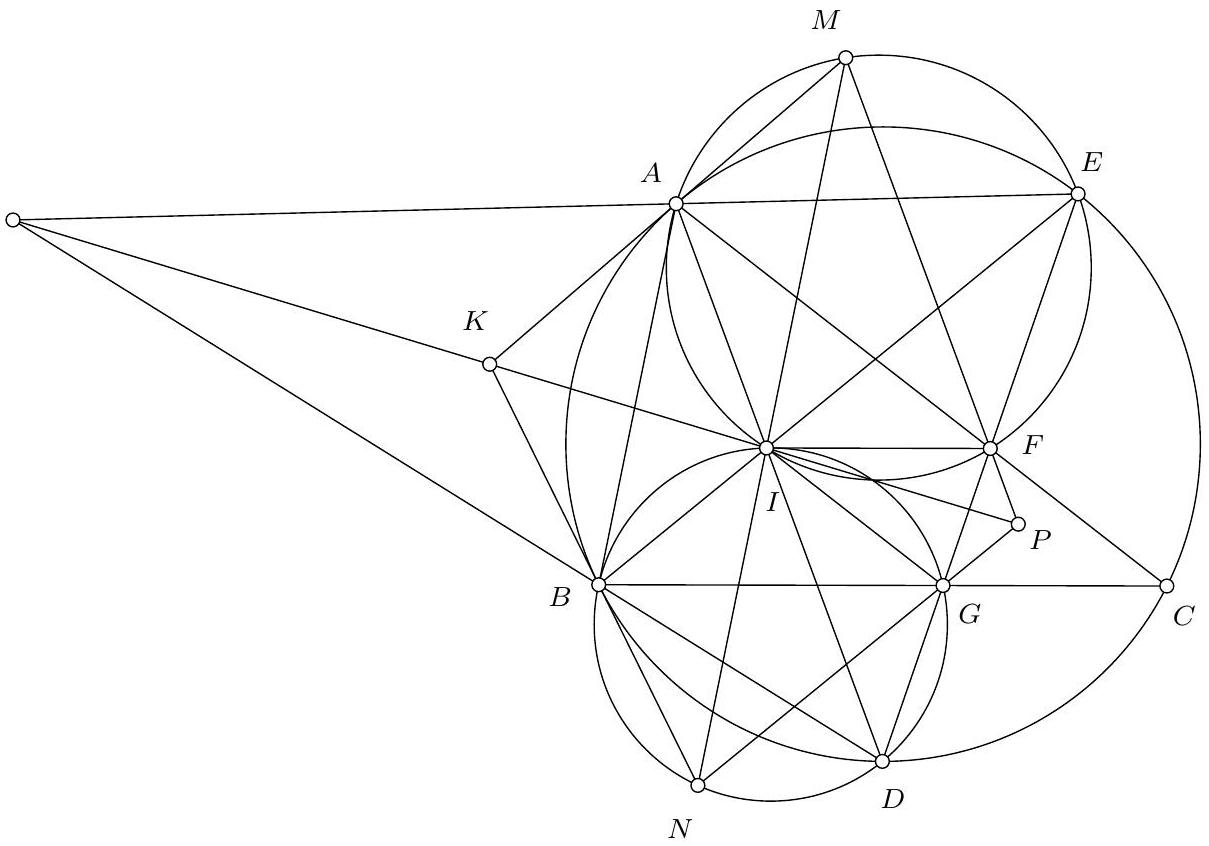
Summarily, points lie on a circle. And similarly, points also lie on a circle. We have known that is perpendicular bisector of , so it is easy to see that is a rhombus. From that above, we get
then . Similarly , implies that are collinear. But from , , we have and are isosceles trapezoids, so
then is also an isosceles trapezoid, which means that it is cyclic.
In the other hand, we get
so is cyclic.
From (1) and (2), we have is the radical axis of two circles and . Now on, we can easily take the conclusion of this problem.
Want a route through all this instead of an archive? The track
puts 2,604 problems in a working order, from Junior Challenge level to the IMO shortlist.