Maths Olympiad Prep

Library / /32 of 55

, 2006

Geometry Difficulty 8.8 Shortlist Prove it IMO

Circles ω1\omega_{1} and ω2\omega_{2} with centres O1O_{1} and O2O_{2} are externally tangent at point DD and internally tangent to a circle ω\omega at points EE and FF, respectively. Line tt is the common tangent of ω1\omega_{1} and ω2\omega_{2} at DD. Let ABAB be the diameter of ω\omega perpendicular to tt, so that AA, EE and O1O_{1} are on the same side of tt. Prove that lines AO1A O_{1}, BO2B O_{2}, EFEF and tt are concurrent.

(Brasil)

Solutions — 2

Solution 1

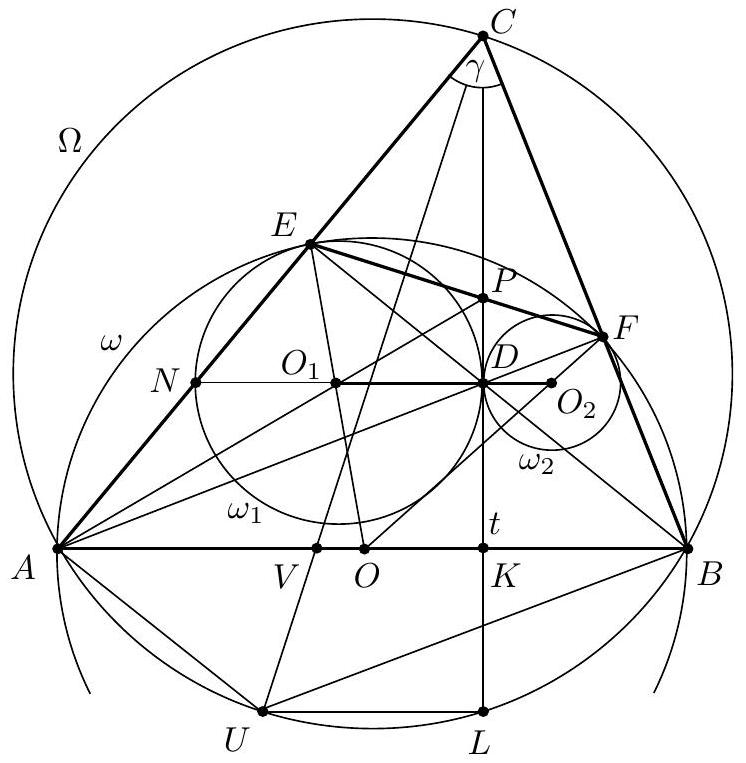
Point EE is the centre of a homothety hh which takes circle ω1\omega_{1} to circle ω\omega. The radii O1DO_{1} D and OBO B of these circles are parallel as both are perpendicular to line tt. Also, O1DO_{1} D and OBO B are on the same side of line EOE O, hence hh takes O1DO_{1} D to OBO B. Consequently, points EE, DD and BB are collinear. Likewise, points FF, DD and AA are collinear as well.
Let lines AEA E and BFB F intersect at CC. Since AFA F and BEB E are altitudes in triangle ABCA B C, their common point DD is the orthocentre of this triangle. So CDC D is perpendicular to ABA B, implying that CC lies on line tt. Note that triangle ABCA B C is acute-angled. We mention the well-known fact that triangles FECF E C and ABCA B C are similar in ratio cosγ\cos \gamma, where γ=ACB\gamma=\angle A C B. In addition, points CC, EE, DD and FF lie on the circle with diameter CDC D.
Figure 1
Let PP be the common point of lines EFE F and tt. We are going to prove that PP lies on line AO1A O_{1}. Denote by NN the second common point of circle ω1\omega_{1} and ACA C; this is the point of ω1\omega_{1} diametrically opposite to DD. By Menelaus' theorem for triangle DCND C N, points AA, O1O_{1} and PP are collinear if and only if
CAANNO1O1DDPPC=1. \frac{C A}{A N} \cdot \frac{N O_{1}}{O_{1} D} \cdot \frac{D P}{P C}=1 .
Because NO1=O1DN O_{1}=O_{1} D, this reduces to CA/AN=CP/PDC A / A N=C P / P D. Let line tt meet ABA B at KK. Then CA/AN=CK/KDC A / A N=C K / K D, so it suffices to show that
CPPD=CKKD. \begin{equation*} \frac{C P}{P D}=\frac{C K}{K D} . \tag{1} \end{equation*}
To verify (1), consider the circumcircle Ω\Omega of triangle ABCA B C. Draw its diameter CUC U through CC, and let CUC U meet ABA B at VV. Extend CKC K to meet Ω\Omega at LL. Since ABA B is parallel to ULU L, we have ACU=BCL\angle A C U=\angle B C L. On the other hand EFC=BAC\angle E F C=\angle B A C, FEC=ABC\angle F E C=\angle A B C and EF/AB=cosγE F / A B=\cos \gamma, as stated above. So reflection in the bisector of ACB\angle A C B followed by a homothety with centre CC and ratio 1/cosγ1 / \cos \gamma takes triangle FECF E C to triangle ABCA B C. Consequently, this transformation
takes CDC D to CUC U, which implies CP/PD=CV/VUC P / P D=C V / V U. Next, we have KL=KDK L=K D, because DD is the orthocentre of triangle ABCA B C. Hence CK/KD=CK/KLC K / K D=C K / K L. Finally, CV/VU=CK/KLC V / V U=C K / K L because ABA B is parallel to ULU L. Relation (1) follows, proving that PP lies on line AO1A O_{1}. By symmetry, PP also lies on line AO2A O_{2} which completes the solution.

Solution 2

We proceed as in the first solution to define a triangle ABCA B C with orthocentre DD, in which AFA F and BEB E are altitudes.
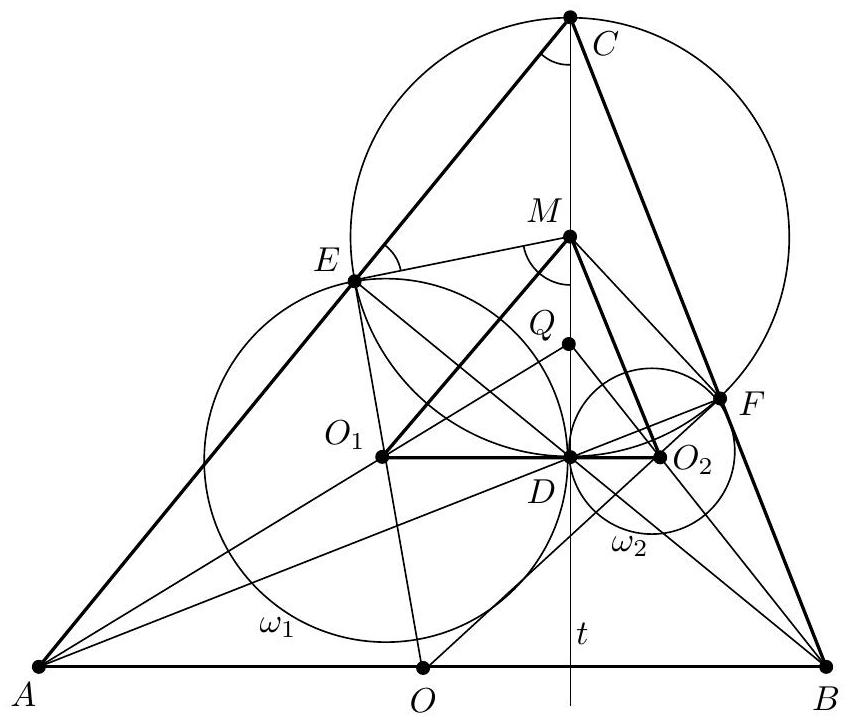
Denote by MM the midpoint of CDC D. The quadrilateral CEDFC E D F is inscribed in a circle with centre MM, hence MC=ME=MD=MFM C=M E=M D=M F.
Figure 2
Consider triangles ABCA B C and O1O2MO_{1} O_{2} M. Lines O1O2O_{1} O_{2} and ABA B are parallel, both of them being perpendicular to line tt. Next, MO1M O_{1} is the line of centres of circles ( CEFC E F ) and ω1\omega_{1} whose common chord is DED E. Hence MO1M O_{1} bisects DME\angle D M E which is the external angle at MM in the isosceles triangle CEMC E M. It follows that DMO1=DCA\angle D M O_{1}=\angle D C A, so that MO1M O_{1} is parallel to ACA C. Likewise, MO2M O_{2} is parallel to BCB C.
Thus the respective sides of triangles ABCA B C and O1O2MO_{1} O_{2} M are parallel; in addition, these triangles are not congruent. Hence there is a homothety taking ABCA B C to O1O2MO_{1} O_{2} M. The lines AO1A O_{1}, BO2B O_{2} and CM=tC M=t are concurrent at the centre QQ of this homothety.
Finally, apply Pappus' theorem to the triples of collinear points A,O,BA, O, B and O2,D,O1O_{2}, D, O_{1}. The theorem implies that the points ADOO2=FA D \cap O O_{2}=F, AO1BO2=QA O_{1} \cap B O_{2}=Q and OO1BD=EO O_{1} \cap B D=E are collinear. In other words, line EFE F passes through the common point QQ of AO1A O_{1}, BO2B O_{2} and tt.

Want a route through all this instead of an archive? The track puts 2,000 problems in a working order, from AMC 10 level to the IMO shortlist.

Source: MathNet, licensed CC-BY-4.0. Statement and solution reproduced as published; topic and difficulty added by this site.