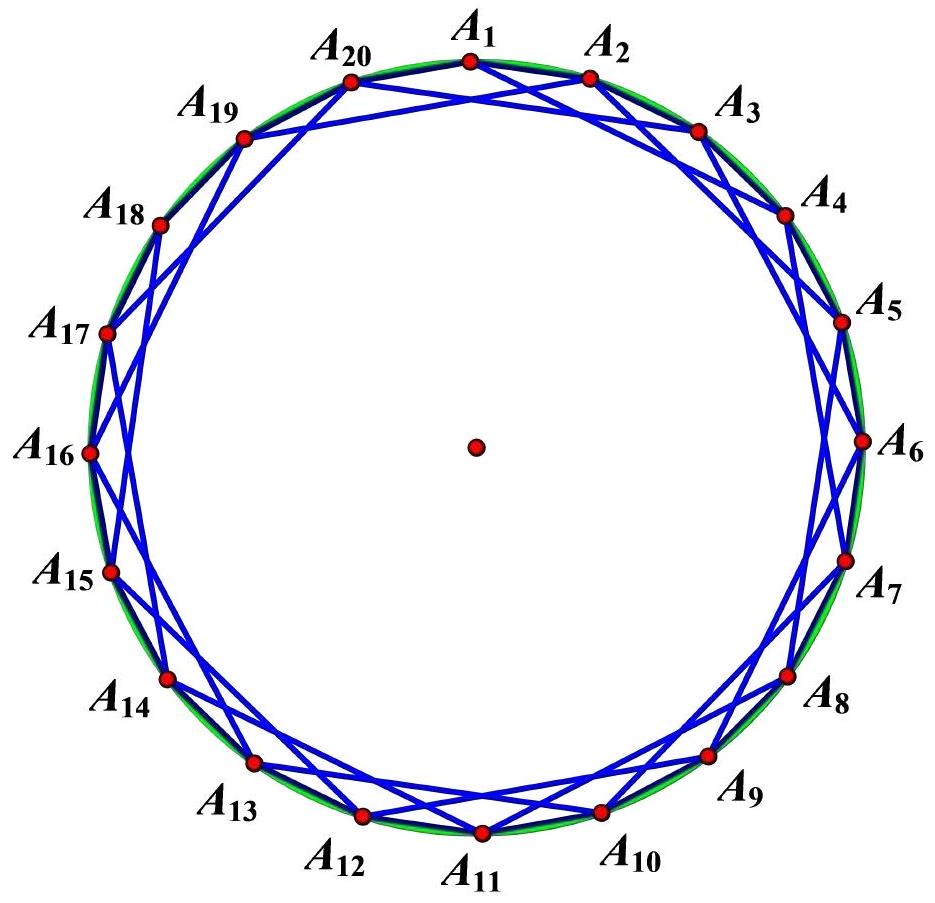
1) Define the diagonal with two black endpoints as the black diagonal and the diagonal with two blue endpoints as the blue diagonal. Firstly, consider the sequence of vertices:
A1→A4→A7→A10→A13→A16→A19→A2→A5→A8→A11→A14→A17→A20→A3→A6→A9→A12→A15→A18
The diagonal connecting two adjacent vertices has the same length as A1A4.
Because the vertices are painted by black and blue, then they can be divided into some blocks of black vertices and some blocks of blue vertices. It is easy to see that one black block lies between two blue blocks and one blue block lies between two black blocks, which implies that the number of black blocks and blue blocks are equal, denote this number as k.
Notice that in each black block of size a, the number of black diagonals is a−1. By summing all the black diagonals among k black block(s), we can see that the number of black diagonals equals the total black points minus the number of blocks, i.e. 10−k.
Similarly, the number of blue diagonals is 10−k. Therefore, the number of black diagonals is equal to the number of blue diagonals.
2) From part 1), the number of black diagonals is equal to 10−k with 1≤k≤10. It is easy to see that with each k∈{1,2,3,…,10}, we can find a way to paint the vertices such that there are exactly k black block(s).