Maths Olympiad Prep

Library / Balkan Mathematical Olympiad Shortlist /9 of 13

Balkan Mathematical Olympiad Shortlist

Geometry Difficulty 8.0 Shortlist Prove it Balkan Mathematical Olympiad

Let ABCABC be an isosceles triangle, (AB=ACAB = AC). Let DD and EE be two points on the side BCBC such that D∈BED \in BE, E∈DCE \in DC and 2∠DAE=∠BAC2\angle DAE = \angle BAC. Prove that we can construct a triangle XYZXYZ such that XY=BDXY = BD, YZ=DEYZ = DE and ZX=ECZX = EC. Find ∠BAC+∠YXZ\angle BAC + \angle YXZ.

Solutions — 2

Solution 1

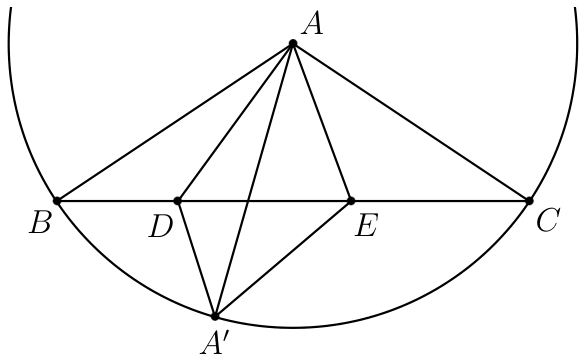
Let ω\omega be the circle of center AA and radius ABAB. Let A′A' be a point on the circle ω\omega, lying on the minor arc BC^\widehat{BC}, such that ∠BAD=∠A′AD\angle BAD = \angle A'AD. Since 2∠DAE=∠A2\angle DAE = \angle A, it is easy to see that ∠CAE=∠A′AE\angle CAE = \angle A'AE.

Figure 1

We deduce that the triangles BADBAD and A′ADA'AD are congruent by SAS postulate, and thus BD=A′DBD = A'D. Similarly, EC=A′EEC = A'E, and thus, the triangle A′DEA'DE has its sides of lengths BDBD, DEDE and ECEC respectively, and we can choose X=A′X = A', Y=DY = D and Z=EZ = E.

Moreover,
∠BAC+∠YXZ=∠BAC+∠DA′E=∠BAC+∠DA′A+∠AA′E=∠BAC+∠DBA+∠ACE=180∘. \begin{align*} \angle BAC + \angle YXZ &= \angle BAC + \angle DA'E \\ &= \angle BAC + \angle DA'A + \angle AA'E \\ &= \angle BAC + \angle DBA + \angle ACE = 180^{\circ}. \end{align*}

Solution 2

Let MM be the midpoint of BCBC. Obviously D∈BMD \in BM and E∈MCE \in MC. We make now the following notations ∠A=2t\angle A = 2t, BC=2aBC = 2a, BD=xBD = x, EC=zEC = z and DE=yDE = y. It is clear that DE=2a−x−zDE = 2a - x - z.

On the other hand, AM=a⋅cot⁡tAM = a \cdot \cot t. But t=∠DAM+∠MAEt = \angle DAM + \angle MAE, and thus we get:
cot⁡(t)=cot⁡∠DAM⋅cot⁡∠MAE−1cot⁡∠DAM+cot⁡∠MAE(1) \cot(t) = \frac{\cot \angle DAM \cdot \cot \angle MAE - 1}{\cot \angle DAM + \cot \angle MAE} \quad (1)
Denoting x+z=sx + z = s and x⋅z=px \cdot z = p, using the relation (1), we get:
a2(1+cot⁡2t)=a⋅s(1+cot⁡2t)−p. a^2(1 + \cot^2 t) = a \cdot s(1 + \cot^2 t) - p.
Now, from the above relation, we get:
s=a+pasin⁡2t. s = a + \frac{p}{a} \sin^2 t.
Finally, we obtain:
y2=(2a−s)2=x2+2x⋅zcos⁡(2t)+z2. y^2 = (2a - s)^2 = x^2 + 2x \cdot z \cos(2t) + z^2.
Now, on the two sides of an angle of the vertex XX and measure π−A\pi - A, we choose the points YY and ZZ such that XY=xXY = x and XZ=zXZ = z. From the cosine rule we have:
YZ2=x2+2x⋅zcos⁡(2t)+z2=y2 YZ^2 = x^2 + 2x \cdot z \cos(2t) + z^2 = y^2
and thus the existence of the triangle XYZXYZ is proved. Moreover, we have ∠BAC+∠YXZ=180∘\angle BAC + \angle YXZ = 180^{\circ}.

Want a route through all this instead of an archive? The track puts 2,604 problems in a working order, from Junior Challenge level to the IMO shortlist.

Source: MathNet, licensed CC-BY-4.0. Statement reproduced verbatim; metadata (topic, difficulty) added by this project.