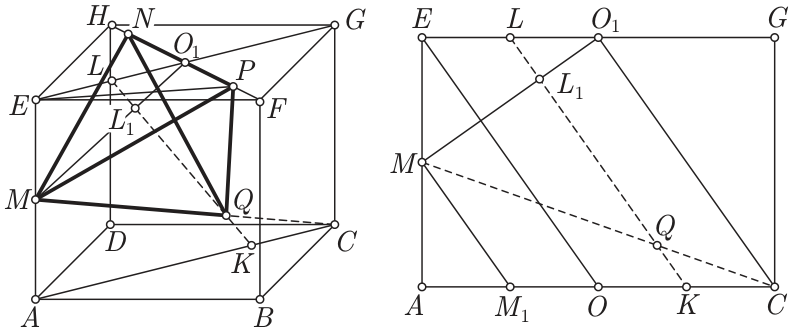
We consider the cube ABCDEFGH with side a cm, a>0 and the points K, L on the segments AC, respectively EG such that CK=EL=4AC. Let M be the midpoint of AE and the points N, P on the segment HF such that HN=FP=2(2−1)a cm. Knowing that lines MC and LK intersect in Q, prove that MNPQ is a regular tetrahedron.
Solution
Triangles ΔMEP and ΔMEN are congruent, therefore MN=MP. Denote by O1 the midpoint of HF. It follows that MO1=2AC=2a3 and, since NP=a, the triangle MNP must be equilateral. Let O be the midpoint of AC, M1 the midpoint of AO and {L1}=LK∩MO1. Since MM1∥EO∥LK∥CO1, we have ML1/MO1=M1K/M1C=2/3 so L1 is the centroid of the triangle MNP.
Notice that AL=AG=432a thus ALGK is a rhombus, which implies AG⊥KL. We also have CO1LK parallelogram, therefore LK∥CO1 and KL⊥MO1. HF⊥(ACGE) so KL⊥HF which implies KL⊥(MNP). It follows that the pyramid MNPQ is regular. From the similarity of the triangles ΔML1Q and ΔMO1C we have QL1=3a6 forcing the tetrahedron MNPQ to be regular.
Want a route through all this instead of an archive? The track
puts 2,604 problems in a working order, from Junior Challenge level to the IMO shortlist.
Source: MathNet,
licensed CC-BY-4.0.
Statement reproduced verbatim; metadata (topic, difficulty) added by this project.