Without loss of generality, assume α=∠BAC⩽β=∠CBA⩽γ=∠ACB. Denote by a, b, c the lengths of BC, CA, AB respectively. We first show that triangle A1B1C1 is acute.
Choose points D and E on side BC such that B1D∥AB and B1E is the internal angle bisector of ∠BB1C. As ∠B1DB=180∘−β is obtuse, we have BB1>B1D. Thus,
ECBE=B1CBB1>B1CDB1=ACBA=A1CBA1
Therefore, BE>BA1 and 21∠BB1C=∠BB1E>∠BB1A1. Similarly, 21∠BB1A>∠BB1C1. It follows that
∠A1B1C1=∠BB1A1+∠BB1C1<21(∠BB1C+∠BB1A)=90∘
is acute. By symmetry, triangle A1B1C1 is acute.
Let BB1 meet A1C1 at F. From α⩽γ, we get a⩽c, which implies
BA1=b+cca⩽a+bac=BC1
and hence ∠BC1A1⩽∠BA1C1. As BF is the internal angle bisector of ∠A1BC1, this shows ∠B1FC1=∠BFA1⩽90∘. Hence, H lies on the same side of BB1 as C1. This shows H lies inside triangle BB1C1. Similarly, from α⩽β and β⩽γ, we know that H lies inside triangles CC1B1 and AA1C1.
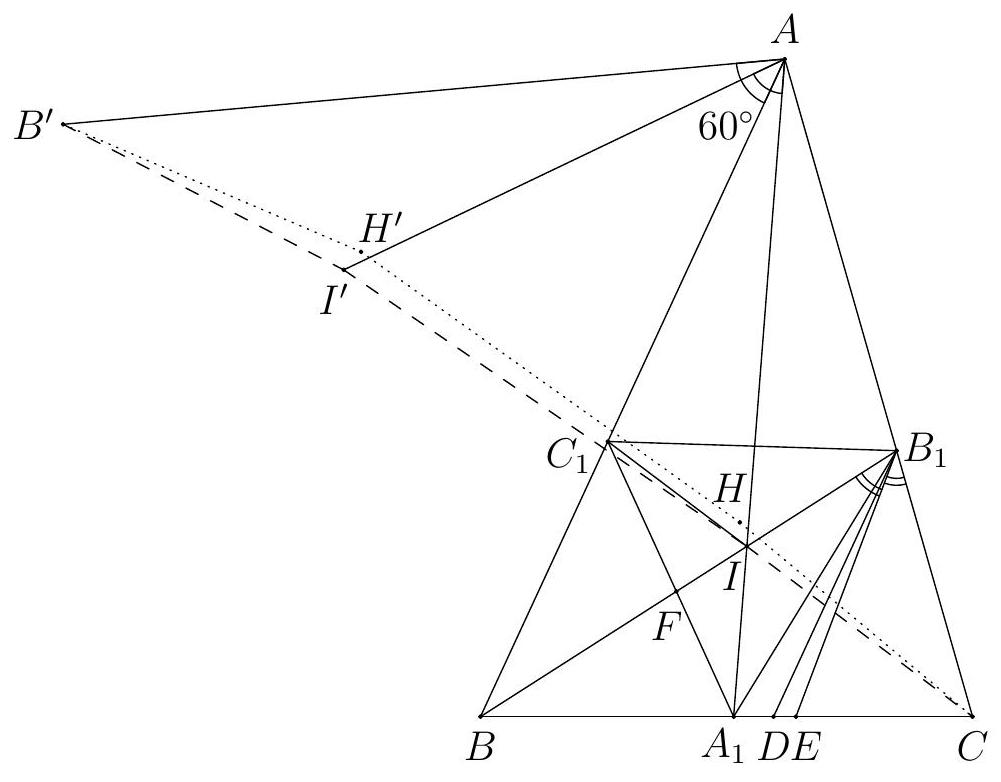
As α⩽β⩽γ, we have α⩽60∘⩽γ. Then ∠BIC⩽120∘⩽∠AIB. Firstly, suppose ∠AIC⩾120∘.
Rotate points B, I, H through 60∘ about A to B′, I′, H′ so that B′ and C lie on different sides of AB. Since triangle AI′I is equilateral, we have
AI+BI+CI=I′I+B′I′+IC=B′I′+I′I+IC(1)
Similarly,
AH+BH+CH=H′H+B′H′+HC=B′H′+H′H+HC(2)
As ∠AII′=∠AI′I=60∘, ∠AI′B′=∠AIB⩾120∘ and ∠AIC⩾120∘, the quadrilateral B′I′IC is convex and lies on the same side of B′C as A.
Next, since H lies inside triangle ACC1, H lies outside B′I′IC. Also, H lying inside triangle ABI implies H′ lies inside triangle AB′I′. This shows H′ lies outside B′I′IC and hence the convex quadrilateral B′I′IC is contained inside the quadrilateral B′H′HC. It follows that the perimeter of B′I′IC cannot exceed the perimeter of B′H′HC. From (1) and (2), we conclude that
AH+BH+CH⩾AI+BI+CI.
For the case ∠AIC<120∘, we can rotate B, I, H through 60∘ about C to B′, I′, H′ so that B′ and A lie on different sides of BC. The proof is analogous to the previous case and we still get the desired inequality.