a.
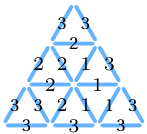
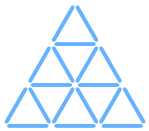
The question of the problem is equivalent to the question how many three-digit numbers whose each digit is 1, 2 or 3 and digits are in non-decreasing order do there exist. There are 10 such numbers (111, 112, 113, 122, 123, 133, 222, 223, 233, 333).
b.
The largest sum of numbers written on 9 sticks is 27. Suppose that the sum of the numbers on the sticks on the boundary of the big triangle is 27. This means that all sticks on the boundary have 3 on it. In all 10 triangles consisting of three sticks, the number 3 occurs 10 times in total. To have 9 occurrences on the boundary, the triangle with 3 on every side must definitely be used. As not all sides of a small triangle can lie on the boundary of the big triangle, at least one stick with number 3 lies in the interior of the big triangle. Thus all 10 occurrences must be used. But the stick in the interior of the big triangle and having 3 on it is a side of another triangle entirely in the interior of the big triangle, whence we have 11 occurrences of 3 when counted by triangles. The contradiction shows that the sum 27 is impossible.
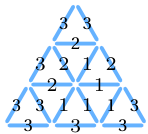
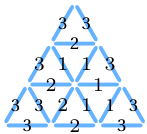
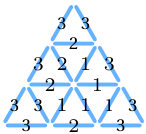
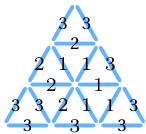
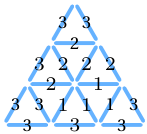
Any of Figures 25, 26, 27, 28 and 29 shows that the sum can be 26.
Remark: Figures 24–29 contain all possibilities, modulo rotations and reflections, for obtaining the sum 26.