Maths Olympiad Prep

Library / /48 of 53

Geometry Difficulty 7.3 National olympiad, round 2 Prove it China

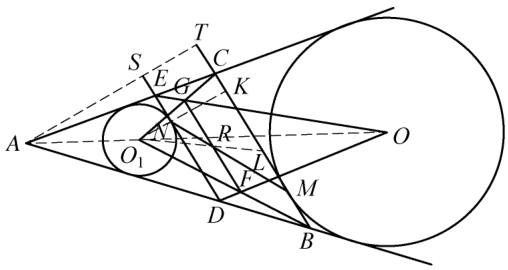
As shown in Fig. 8.1, O\odot O is the inscribed circle touching side BCBC of ABC\triangle ABC at point MM, and points D,ED, E are on the segments AB,ACAB, AC, respectively, satisfying DEBCDE \parallel BC; O1\odot O_1 is the inscribed circle of ADE\triangle ADE tangent to side DEDE at point NN; O1B,DOO_1B, DO intersect at point FF, and O1C,EOO_1C, EO intersect at point GG. Please prove that MNMN divides segment FGFG equally. (posed by Bian Hongping)

Figure 1
Fig. 8.1

Solutions — 2

Solution 1

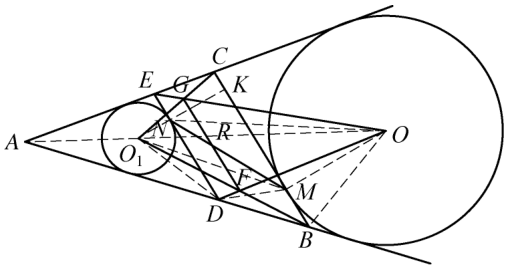
If AB=ACAB = AC, then the graph is symmetric about the bisector of BAC\angle BAC and the conclusion is obvious. So we may assume that AB>ACAB > AC. As shown in Fig. 8.2, let LL be the midpoint of BCBC, line O1LO_1L intersecting with FGFG at RR, and O1NO_1N be extended to intersect with BCBC at KK. Draw line ATAT that is perpendicular to BCBC at TT and intersects with line DEDE at SS. Connecting AOAO, obviously O1O_1 is on the segment AOAO. By Menelaus' theorem, we have

Figure 2
Fig. 8.2

O1FFBBDDAAOOO1=1,O1GGCCEEAAOOO1=1.1 \frac{O_1 F}{F B} \cdot \frac{B D}{D A} \cdot \frac{A O}{O O_1} = 1, \quad \frac{O_1 G}{G C} \cdot \frac{C E}{E A} \cdot \frac{A O}{O O_1} = 1. \qquad \textcircled{1}

Since DEBCDE \parallel BC, we have BDDA=CEEA\frac{BD}{DA} = \frac{CE}{EA}. So O1FFB=O1GGC\frac{O_1 F}{F B} = \frac{O_1 G}{G C}, which means that FGBCFG \parallel BC. Then FRGR=BLCL=1\frac{FR}{GR} = \frac{BL}{CL} = 1. Therefore, RR is the midpoint of FGFG. We now only need to prove that M,R,NM, R, N are collinear. For this purpose, by the inverse of Menelaus' theorem, we only need to prove that

O1RRLLMMKKNNO1=1.2 \frac{O_1 R}{R L} \cdot \frac{L M}{M K} \cdot \frac{K N}{N O_1} = 1. \qquad \textcircled{2}

Since FRBLFR \parallel BL, we have O1RRL=O1FFB=OO1AOADDB\frac{O_1 R}{R L} = \frac{O_1 F}{F B} = \frac{O O_1}{A O} \cdot \frac{A D}{D B} (the second equality is justified by ①). So we only need to prove that

OO1AOADDBLMMKKNNO1=1.3 \frac{O O_1}{A O} \cdot \frac{A D}{D B} \cdot \frac{L M}{M K} \cdot \frac{K N}{N O_1} = 1. \qquad \textcircled{3}

Since O1KDEO_1 K \perp DE, OMBCO M \perp BC, ATBCA T \perp BC, DEBCDE \parallel BC, then lines O1KO_1 K, OMO M, ATA T are parallel. By the theorem of dividing the segments into proportional by parallel lines, we have OO1AO=MKMT\frac{O O_1}{A O} = \frac{M K}{M T}. Substituting it into ③, we then only need to prove

ADDBLMMTKNNO1=1.4 \frac{A D}{D B} \cdot \frac{L M}{M T} \cdot \frac{K N}{N O_1} = 1. \qquad \textcircled{4}

Since DEBCDE \parallel BC, KNDEK N \perp DE, STBCS T \perp BC, quadrilateral KNSTK N S T is a rectangle and then KN=STK N = S T. Furthermore, from DSBTD S \parallel B T we have ADDB=ASST\frac{A D}{D B} = \frac{A S}{S T}. Substituting these results into ④, we now only need to prove

LMMT=NO1AS.5 \frac{LM}{MT} = \frac{NO_1}{AS}. \qquad \textcircled{5}

Let BC=aBC = a, AC=bAC = b, AB=cAB = c. We have

BM=a+bc2 (the property of an inscribed circle),BL=a2, BM = \frac{a+b-c}{2} \text{ (the property of an inscribed circle)}, \quad BL = \frac{a}{2},
BT=ccosABC=ca2+c2b22ac=a2+c2b22a. BT = c \cos \angle ABC = c \cdot \frac{a^2 + c^2 - b^2}{2ac} = \frac{a^2 + c^2 - b^2}{2a}.
Then
LMMT=BLBMBTBM=cb2c2b2+a(cb)2a=aa+b+c. \frac{LM}{MT} = \frac{BL - BM}{BT - BM} = \frac{\frac{c-b}{2}}{\frac{c^2 - b^2 + a(c-b)}{2a}} = \frac{a}{a+b+c}.
On the other hand,
NO1AS=2SADEAD+DE+AE2SADEDE=DEAD+DE+AE=aa+b+c. \frac{NO_1}{AS} = \frac{\frac{2S_{\triangle ADE}}{AD + DE + AE}}{\frac{2S_{\triangle ADE}}{DE}} = \frac{DE}{AD + DE + AE} = \frac{a}{a+b+c}.
Therefore, ⑤ holds. The proof is complete.
Solution 2

Let the radii of O\odot O and O1\odot O_1 be rr and r1r_1, respectively. Obviously, O1O_1, OO and AA are collinear.
DE//BCABBD=ACCEOFFD=SBOO1SDBO1=12(ABsinA2)OO112r1BDOGGE=SOO1CSEOO1=12(ACsinA2)OO112r1CEFGDEBC.}OFFD=OGGE \left. \begin{array}{l} DE // BC \Rightarrow \frac{AB}{BD} = \frac{AC}{CE} \\[2ex] \frac{OF}{FD} = \frac{S_{\triangle BOO_1}}{S_{\triangle DBO_1}} = \frac{\frac{1}{2}\left(AB \sin \frac{A}{2}\right) \cdot OO_1}{\frac{1}{2}r_1 \cdot BD} \\[2ex] \frac{OG}{GE} = \frac{S_{\triangle OO_1C}}{S_{\triangle EOO_1}} = \frac{\frac{1}{2}\left(AC \sin \frac{A}{2}\right) \cdot OO_1}{\frac{1}{2}r_1 \cdot CE} \\[2ex] \Rightarrow FG \parallel DE \parallel BC. \end{array} \right\} \Rightarrow \frac{OF}{FD} = \frac{OG}{GE}

Connect ONON and extend it to intersect with BCBC at KK. If ABC=ACB\angle ABC = \angle ACB, then by symmetry, the proposition holds. So we may assume that ABC<ACB\angle ABC < \angle ACB in the following.
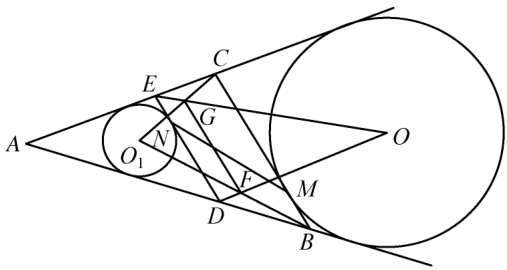
We connect OM,O1M,OB,MD,DO1OM, O_1M, OB, MD, DO_1, respectively (see Fig. 8.3). Since O1NOMO_1N \parallel OM, we have

Figure 3
Fig. 8.3

SONM=SMOO1=12rOO1sinCB2, S_{\triangle ONM} = S_{\triangle MOO_1} = \frac{1}{2} r \cdot OO_1 \cdot \sin \frac{C-B}{2}, \qquad ①
OGGE=OFDF=SBOO1SBDO1=12BOOO1sinC212BDDO1sinB2 \frac{OG}{GE} = \frac{OF}{DF} = \frac{S_{\triangle BOO_1}}{S_{\triangle BDO_1}} = \frac{\frac{1}{2}BO \cdot OO_1 \cdot \sin \frac{C}{2}}{\frac{1}{2} \cdot BD \cdot DO_1 \cdot \sin \frac{B}{2}}
=rOO1sinC2r1BDcosB2 = \frac{r \cdot OO_1 \cdot \sin \frac{C}{2}}{r_1 \cdot BD \cdot \cos \frac{B}{2}} \qquad ②
(r=BOcosB2,r1=DO1sinB2), (r = BO \cdot \cos \frac{B}{2}, r_1 = DO_1 \cdot \sin \frac{B}{2}),
SDMNSMEN=12NKDNNE=12BDsinB(r1cotB2r1cotC2). S_{\triangle DMN} - S_{\triangle MEN} = \frac{1}{2}NK \cdot DN - NE \\ = \frac{1}{2}BD \cdot \sin B \cdot \left( r_1 \cot \frac{B}{2} - r_1 \cot \frac{C}{2} \right). \quad ③
From ② and ③, we have
OGGESDMNSMEN=12r1BDsinB(cotB2cotC2)rOO1sinC2r1BDcosB2=rOO1sinB2sinC2(cotB2cotC2)=rOO1sinCB2. \begin{align*} & \frac{OG}{GE} S_{\triangle DMN} - S_{\triangle MEN} \\ &= \frac{1}{2} r_1 \cdot BD \cdot \sin B \cdot \left( \cot \frac{B}{2} - \cot \frac{C}{2} \right) \cdot \frac{r \cdot OO_1 \cdot \sin \frac{C}{2}}{r_1 \cdot BD \cdot \cos \frac{B}{2}} \\ &= r \cdot OO_1 \cdot \sin \frac{B}{2} \cdot \sin \frac{C}{2} \cdot \left( \cot \frac{B}{2} - \cot \frac{C}{2} \right) \\ &= r \cdot OO_1 \cdot \sin \frac{C-B}{2}. \end{align*}
Combining it with ①, we get
OGGE(SDMNSMEN)=2SMON. \frac{OG}{GE} (S_{\triangle DMN} - S_{\triangle MEN}) = 2S_{\triangle MON}.
Since OGGE:2=OGOE:(DFOD+EGOE)\frac{OG}{GE} : 2 = \frac{OG}{OE} : \left(\frac{DF}{OD} + \frac{EG}{OE}\right), then
OFODSMNDOGOESMEN=(DFOD+EGOE)SMON,OFSMNDDFSMONOD=OGSMEN+EGSMONOE. \frac{OF}{OD} \cdot S_{\triangle MND} - \frac{OG}{OE} \cdot S_{\triangle MEN} = \left(\frac{DF}{OD} + \frac{EG}{OE}\right) \cdot S_{\triangle MON}, \\ \frac{OF \cdot S_{\triangle MND} - DF \cdot S_{\triangle MON}}{OD} = \frac{OG \cdot S_{\triangle MEN} + EG \cdot S_{\triangle MON}}{OE}. \quad ④
On the other hand,
SNMG=SMENOG+EGSMONOE. S_{\triangle NMG} = \frac{S_{\triangle MEN} \cdot OG + EG \cdot S_{\triangle MON}}{OE}.
Therefore, SNMG=OFSMNDDFSMONOD. \text{Therefore, } S_{\triangle NMG} = \frac{OF \cdot S_{\triangle MND} - DF \cdot S_{\triangle MON}}{OD}.
In the same way,
SNMF=OFSMNDDFSMONOD. S_{\triangle NMF} = \frac{OF \cdot S_{\triangle MND} - DF \cdot S_{\triangle MON}}{OD}.
By ④, we have SNMG=SNMFS_{\triangle NMG} = S_{\triangle NMF}. Therefore, MNMN divides segment FGFG equally.
The proof is complete.

Want a route through all this instead of an archive? The track puts 2,000 problems in a working order, from AMC 10 level to the IMO shortlist.

Source: MathNet, licensed CC-BY-4.0. Statement and solution reproduced as published; topic and difficulty added by this site.