Maths Olympiad Prep

Library / /48 of 50

Geometry Difficulty 6.7 National olympiad Prove it Belarus

Points C1C_1 and B1B_1 are marked on the sides ABAB and ACAC of the triangle ABCABC respectively. Segments BB1BB_1 and CC1CC_1 intersect at point XX, and segments B1C1B_1C_1 and AXAX intersect at point A1A_1. The circumcircles of the triangles BXC1BXC_1 and CXB1CXB_1 intersect the side BCBC at points DD and EE respectively. Lines B1DB_1D and C1EC_1E intersect at point FF.
Prove that the lines A1FA_1F, B1EB_1E and C1DC_1D are either parallel or concurrent.

Solution

First we prove the equality
B1EC1D=B1A1C1A1. \frac{B_1 E}{C_1 D} = \frac{B_1 A_1}{C_1 A_1}.
Since the quadrilateral XB1CEXB_1CE is cyclic, XB1E=XCE\angle XB_1E = \angle XCE. Therefore, the triangle BB1EBB_1E is similar to the triangle BCXBCX. Hence,
B1EXC=BB1BC.(1) \frac{B_1 E}{X C} = \frac{B B_1}{B C}. \qquad (1)
Similarly one can prove the equality
C1DXB=CC1BC.(2) \frac{C_1 D}{X B} = \frac{C C_1}{B C}. \qquad (2)
Hence, dividing equation (1) by equation (2), we get
B1EC1D=XCXBBB1CC1. \frac{B_1 E}{C_1 D} = \frac{X C}{X B} \cdot \frac{B B_1}{C C_1}.
Applying Menelaus' theorem to the triangle XB1CXB_1C and the line ABAB we obtain
XC1CC1ACAB1BB1XB=1.(3) \frac{X C_1}{C C_1} \cdot \frac{A C}{A B_1} \cdot \frac{B B_1}{X B} = 1. \qquad (3)
Further, the same arguments applied to the triangle CC1B1CC_1B_1 and the line AXAX imply the equality
C1A1B1A1AB1ACXCXC1=1.(4) \frac{C_1 A_1}{B_1 A_1} \cdot \frac{A B_1}{A C} \cdot \frac{X C}{X C_1} = 1. \qquad (4)
Thus, multiplying equalities (3) and (4), we obtain
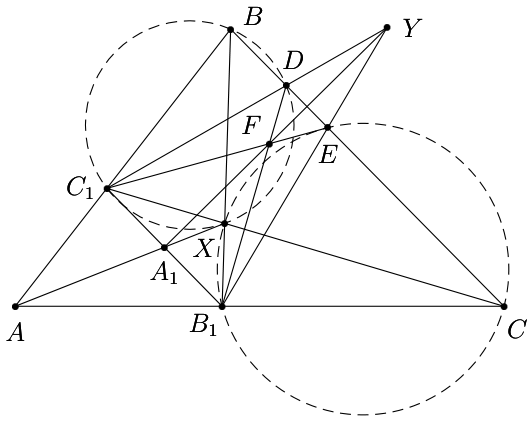
B1A1C1A1=XCXBBB1CC1=B1EC1D. \frac{B_1 A_1}{C_1 A_1} = \frac{X C}{X B} \cdot \frac{B B_1}{C C_1} = \frac{B_1 E}{C_1 D}.

Figure 1

B1FFD=B1EC1D=B1A1C1A1, \frac{B_1F}{FD} = \frac{B_1E}{C_1D} = \frac{B_1A_1}{C_1A_1},
so A1FC1DA_1F \parallel C_1D.
Suppose that the lines B1EB_1E and C1DC_1D intersect at point YY. To prove the statement of the problem it is sufficient to show that the lines YA1YA_1, B1DB_1D and C1EC_1E intersect at the same point. Let us prove the equality YD=YEYD = YE. Indeed, since the quadrilaterals XB1CEXB_1CE and XC1BDXC_1BD are cyclic,
DEY=CEB1=CXB1=C1XB=C1DB=EDY. \angle DEY = \angle CEB_1 = \angle CXB_1 = \angle C_1XB = \angle C_1DB = \angle EDY.
Therefore, the triangle YDEYDE is isosceles. Since
YEB1EB1A1C1A1C1DYD=B1A1C1A1C1DB1E=1, \frac{YE}{B_1E} \cdot \frac{B_1A_1}{C_1A_1} \cdot \frac{C_1D}{YD} = \frac{B_1A_1}{C_1A_1} \cdot \frac{C_1D}{B_1E} = 1,
so Ceva's theorem implies that the lines YA1YA_1, B1DB_1D and C1EC_1E intersect at the same point.

Want a route through all this instead of an archive? The track puts 2,000 problems in a working order, from AMC 10 level to the IMO shortlist.

Source: MathNet, licensed CC-BY-4.0. Statement and solution reproduced as published; topic and difficulty added by this site.