Maths Olympiad Prep

Library / /12 of 19

Geometry Difficulty 6.5 National olympiad Prove it Romania

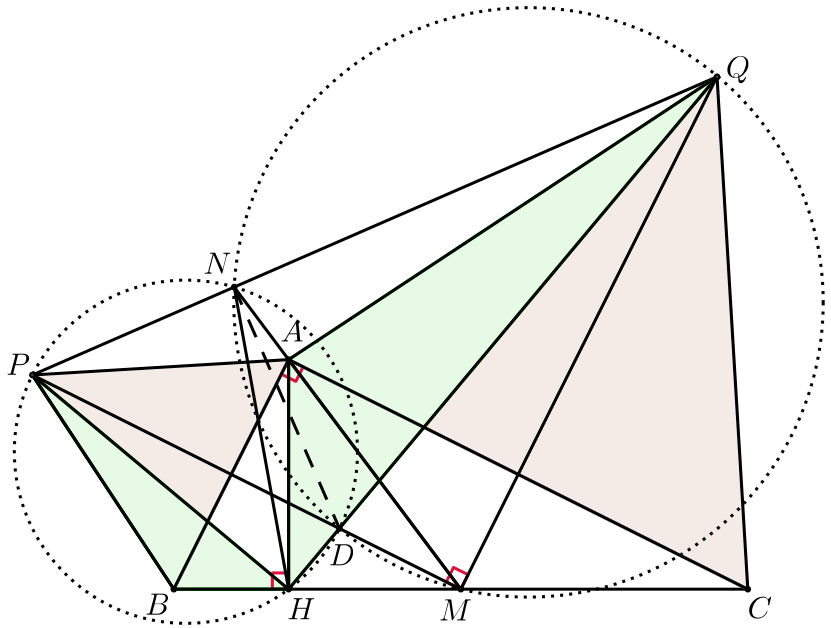
Let ABCABC be a right triangle, with the right angle at AA. The altitude from AA meets BCBC at HH and MM is the midpoint of the hypotenuse [BC][BC]. On the legs, in the exterior of the triangle, equilateral triangles BAPBAP and ACQACQ are constructed. If NN is the intersection point of the lines AMAM and PQPQ, prove that the angles NHP\angle NHP and AHQ\angle AHQ are equal.

Miguel Ochoa Sanchez, Peru, and Leonard Giugiuc

Solutions — 2

Solution 1

If AB=ACAB = AC, the statement is obvious. In the following, we assume AB<ACAB < AC, the other case being similar.

* Triangles PAMPAM and PBMPBM are congruent (SSS), hence PMAPMB\angle PMA \equiv \angle PMB. Similarly, QMAQMC\angle QMA \equiv \angle QMC, and this leads rapidly to PMQ=90\angle PMQ = 90^\circ.

As tanB=AHBH=ACAB=AQBP\tan B = \frac{AH}{BH} = \frac{AC}{AB} = \frac{AQ}{BP} and HAQ=HBP=60+B\angle HAQ = \angle HBP = 60^\circ + \angle B, triangles HAQHAQ and HBPHBP are similar (SAS).

It follows that QHA=PHB\angle QHA = \angle PHB, hence QHP=QHA+AHP=PHB+AHP=AHB=90\angle QHP = \angle QHA + \angle AHP = \angle PHB + \angle AHP = \angle AHB = 90^\circ.

In conclusion, the points P,Q,MP, Q, M and HH are co-cyclic, hence HPQCMQAMQ\angle HPQ \equiv \angle CMQ \equiv \angle AMQ.

Let {D}=HQMP\{D\} = HQ \cap MP. The angle MNQ\angle MNQ is exterior to the triangle PMNPMN, therefore MNQ=MPN+NMP=MHQ+BMP=MDQ\angle MNQ = \angle MPN + \angle NMP = \angle MHQ + \angle BMP = \angle MDQ. (1)

It follows that the quadrilateral NDMQNDMQ is cyclic, hence DNQ=90\angle DNQ = 90^\circ. This means that NDHPNDHP is also cyclic, therefore PNHPDH\angle PNH \equiv \angle PDH. (2)

From (1) and (2) it follows that PNHPDHMDQMNQ\angle PNH \equiv \angle PDH \equiv \angle MDQ \equiv \angle MNQ, i.e. (NDND is the bisector of angle HNM\angle HNM). For the triangle HMNHMN ray (NPNP is the external bisector, while (MPMP is an internal bisector, which means that PP is the excenter opposite to the vertex MM). Then (HPHP is the internal bisector of angle NHB\angle NHB.

Finally, NHPPHBAHQ\angle NHP \equiv \angle PHB \equiv \angle AHQ.

Solution 2

(given in the contest by Paul Bécsi)

Let {S}=AHPQ\{S\} = AH \cap PQ. An easy computation shows that SAQ=NAP=120B\angle SAQ = \angle NAP = 120^\circ - \angle B, which shows that the rays (ANAN and (ASAS are isogonal in the angle PAQ\angle PAQ). From Steiner's Theorem it follows that PNNQPSSQ=(PAAQ)2\frac{PN}{NQ} \cdot \frac{PS}{SQ} = \left(\frac{PA}{AQ}\right)^2.

The conclusion means the rays (HNHN and (HSHS are isogonal in the angle PHQ\angle PHQ, which, according to Steiner's Theorem, is equivalent to PNNQPSSQ=(PHHQ)2\frac{PN}{NQ} \cdot \frac{PS}{SQ} = \left(\frac{PH}{HQ}\right)^2.

In conclusion, we need to prove that PAAQ=PHHQ\frac{PA}{AQ} = \frac{PH}{HQ}.

Figure 1

But ΔBHAΔBAC\Delta BHA \sim \Delta BAC leads to BHHA=BACA=BPCQ\frac{BH}{HA} = \frac{BA}{CA} = \frac{BP}{CQ}. As PBH=60+B=QAH\angle PBH = 60^\circ + \angle B = \angle QAH, it follows that ΔPBHΔQAH\Delta PBH \sim \Delta QAH, i.e., PHQH=PBAQ=PAAQ\frac{PH}{QH} = \frac{PB}{AQ} = \frac{PA}{AQ} and the conclusion.

Want a route through all this instead of an archive? The track puts 2,000 problems in a working order, from AMC 10 level to the IMO shortlist.

Source: MathNet, licensed CC-BY-4.0. Statement and solution reproduced as published; topic and difficulty added by this site.