Maths Olympiad Prep

Library / /6 of 6

Geometry Difficulty 7.0 National olympiad, round 2 Prove it Romania

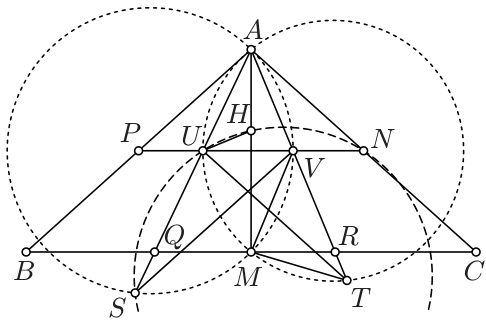
Let ABCABC be an isosceles triangle with apex at AA, and let M,N,PM, N, P be the midpoints of the sides BC,CA,ABBC, CA, AB, respectively. Let QQ and RR be points inside the segments BMBM and CMCM, respectively, so that BAQ=MAR\angle BAQ = \angle MAR. The segment NPNP crosses AQAQ and ARAR at UU and VV, respectively. The point SUS \neq U lies on the half-line AQAQ emanating from AA, so that SVSV is the internal bisector of ASM\angle ASM. Similarly, TVT \neq V is a point on the half-line ARAR emanating from AA, so that TUTU is the internal bisector of ATM\angle ATM. Prove that one of the points where the circles NUSNUS and PVTPVT meet lies on the line AMAM.
Flavian Georgescu

Solution

Figure 1
We first show that AVMSAVMS is cyclic. Since the triangle ABCABC is isosceles, AMBCAM \perp BC, and since NPNP is midline, VV is the midpoint of ARAR. Then MVMV is the MM-median of the right triangle AMRAMR, so VM=VA=VRVM = VA = VR. Hence VV lies on the perpendicular bisector of AMAM. By hypothesis, VV also lies on the internal bisector of ASM\angle ASM, so, in the circle AMSAMS, VV is the midpoint of the arc AMAM not containing SS. Consequently, AVMSAVMS is cyclic, as stated. Similarly, AUMTAUMT is cyclic.

We now prove that HH lies on the circle NUSNUS. Since AVMSAVMS is cyclic, ASV=MAR\angle ASV = \angle MAR. By hypothesis, MAR=BAQ\angle MAR = \angle BAQ, so ABSVAB \parallel SV. Similarly, ACTUAC \parallel TU. Then SVP=APV=9012BAC\angle SVP = \angle APV = 90^\circ - \frac{1}{2}\angle BAC, and AUH=90UAV=9012BAC\angle AUH = 90^\circ - \angle UAV = 90^\circ - \frac{1}{2}\angle BAC, so SVP=AUH\angle SVP = \angle AUH.

From the triangles SUVSUV and AUNAUN,
SUSV=sin(9012BAC)sinSUV=AUAN. \frac{SU}{SV} = \frac{\sin(90^\circ - \frac{1}{2}\angle BAC)}{\sin \angle SUV} = \frac{AU}{AN}.
Since UAM=UAH=VAN\angle UAM = \angle UAH = \angle VAN and AUH=9012BAC=ANV\angle AUH = 90^\circ - \frac{1}{2}\angle BAC = \angle ANV, the triangles AUHAUH and ANVANV are similar.
Hence AN/AU=NV/UHAN/AU = NV/UH, so SU/SV=UH/VNSU/SV = UH/VN. Since SVN=180SVP=180AUM=SUH\angle SVN = 180^\circ - \angle SVP = 180^\circ - \angle AUM = \angle SUH, the triangles SUHSUH and SVNSVN are similar, so USH=VSN\angle USH = \angle VSN, whence USV=HSN\angle USV = \angle HSN.
Finally, USV=MAV=90AVU=HUV\angle USV = \angle MAV = 90^\circ - \angle AVU = \angle HUV, so HSN=HUV=HUN\angle HSN = \angle HUV = \angle HUN. Consequently, HH lies on the circle NUSNUS, as stated. Similarly, HH lies on the circle PVTPVT. This ends the proof.

Want a route through all this instead of an archive? The track puts 2,000 problems in a working order, from AMC 10 level to the IMO shortlist.

Source: MathNet, licensed CC-BY-4.0. Statement and solution reproduced as published; topic and difficulty added by this site.