Olympiad Maths Prep

Library / /4 of 5

Geometry Difficulty 6.2 National olympiad Prove it Greece

In a circular ring with radii RR and R2rR-2r, where R=11rR = 11r, we put non overlapping circles of radius rr tangent to the circles defining the circular ring. Determine the maximal number of these circles. (It is given that 9.94<99<9.959.94 < \sqrt{99} < 9.95)

Solution

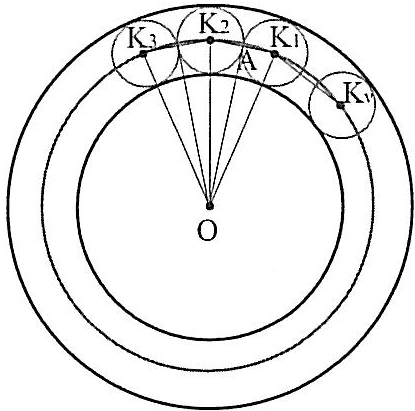
Let we can put NN non overlapping circles Ci(Ki,r)C_i(K_i, r) into the given circular ring tangent to its border. The circle C(O,Rr)C(O, R-r) has length greater than the perimeter K1...KNK1\ell_{K_1...K_N K_1} of the polygon with vertices the centers of the circles Ci(Ki,r)C_i(K_i, r), and therefore:
N2r<K1...KNK1<2π(Rr)N<π(Rr1).(1) N \cdot 2r < \ell_{K_1...K_N K_1} < 2\pi(R-r) \Rightarrow N < \pi \left( \frac{R}{r} - 1 \right). \quad (1)

Figure 1
Figure 2
Figure 2
Figure 3

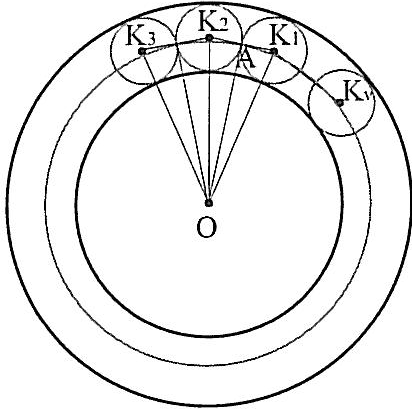
Let OAOA is tangent from OO to one of the circles Ci(Ki,r)C_i(K_i, r). Then
OA2=R(R2r)OA=R(R2r). OA^2 = R(R-2r) \Leftrightarrow OA = \sqrt{R(R-2r)}.
The circle C(O,OA)C(O, OA) is tangent to the sides of the polygon line K1K2,...,KN1KNK_1K_2,...,K_{N-1}K_N and we have
2πR(R2r)<N2r+2rπRr(Rr2)1N(2) 2\pi\sqrt{R(R-2r)} < N \cdot 2r + 2r \Rightarrow \pi\sqrt{\frac{R}{r}\left(\frac{R}{r}-2\right)} - 1 \le N \quad (2)
From (1) and (2) it follows that:
πRr(Rr2)1N<π(Rr1), \pi\sqrt{\frac{R}{r}\left(\frac{R}{r}-2\right)} - 1 \le N < \pi\left(\frac{R}{r}-1\right),
from which, because of the hypothesis R=11rR = 11r, we find
π11(112)1N<π(111)π991N<10π31.4N=31. \pi\sqrt{11(11-2)} - 1 \le N < \pi(11-1) \\ \Leftrightarrow \pi\sqrt{99} - 1 \le N < 10\pi \approx 31.4 \Leftrightarrow N = 31.

Looking for a route rather than an archive? The track puts 2,000 problems in a working order, from AMC 10 level to the IMO shortlist.

Source: MathNet, licensed CC-BY-4.0. Statement and solution reproduced as published; topic and difficulty added by this site.