If α≥90∘, then AB+AC>2h≥2hsinα≥BC⋅cosα+2hsinα, because cosα≤0, that is, the inequality is strict.
Let now α<90∘, denote by H1,H2,H3 the feet of altitudes from vertices A,B,C respectively, K2 be the point symmetric to H2 with respect to line AB and analogously K3 be the point symmetric to H3 with respect to line AC. Denote by ω1 and ω2 the circumscribed circles of the triangles ABH1 and ACH1 respectively (Fig.23). Then AB and AC are diameters of these circles, as ∠AK2B=∠AK3C=90∘, so K2∈ω1 and K3∈ω2. Then AB≥K2H1 and AC≥K3H1.
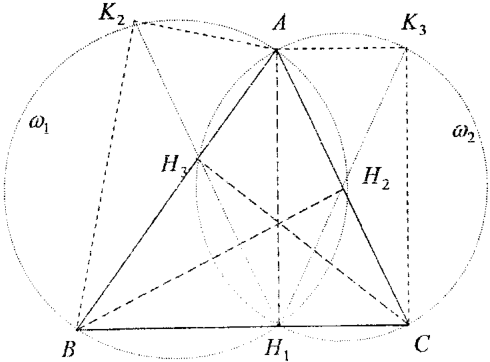
Fig.23
Next, by Ptolemy's theorem AB⋅K2H1=AK2⋅BH1+BK2⋅AH1. This implies
K2H1=ABAK2⋅BH1+ABBK2⋅AH1=ABAH2⋅BH1+ABBH2⋅AH1=BH1cosα+hsinα.
Analogously, K3H1=CH1cosα+hsinα. Then
AB+AC≥K2H1+K3H1=(BH1cosα+hsinα)+(CH1cosα+hsinα)=BCcosα+2hsinα,
the proof is finished.
Equality holds if and only if the segments K2H1 and K3H1 are the diameters of circles ω1 and ω2 respectively. In this case
∠ABC=90∘−∠BAH1=∠BAK2=∠BAC=∠CAK3=90∘−∠CAH1=∠ACB,
then the triangle ABC is equilateral. It is easily checked that the equality holds.