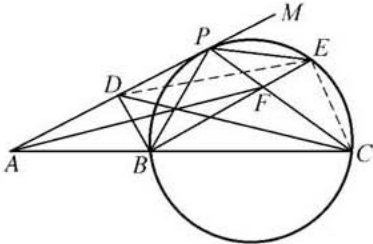
In △PBC, ∠PBC=60∘. The tangent at point P to the circumcircle w of △PBC intersects with line CB at A. Points D and E lie on the line segment PA and circle w respectively, such that ∠DBE=90∘ and PD=PE. BE and PC meet at F. It is given that lines AF, BP and CD are concurrent. (1) Prove that BF is the bisector of ∠PBC; (2) Find the value of tan∠PCB.
Solution
By the angle bisector theorem, we have FCPF⋅BACB⋅DPAD=BCPB⋅BABC⋅PBAB=1. By the converse of Ceva theorem, the lines AF, BP and CD are concurrent. Suppose there exists ∠D′BF′ satisfying the conditions: (a) ∠D′BF′=90∘, (b) the lines AF′, BP and CD′ are concurrent. We may assume that F′ lies on PF. Then, D′ is on AD. So F′CPF′<FCPF,PD′AD′<PDAD. Thus F′CPF′⋅BACB⋅D′PAD′<BCPB⋅BABC⋅PBAB=1, which leads to a contradiction. This completes the proof.
(2) We may assume that the circle O has radius 1. Let
∠PCB=α. By (1), ∠PBE=∠EBC=30∘. Therefore, E is the midpoint of PC. Since ∠MPE=∠PBE=30∘, ∠CPE=∠CBE=30∘ and PD=PE, we obtain ∠PDE=∠PED=15∘, PE=2⋅1⋅sin30∘ and DE=2cos15∘.
Since BE=2sin∠ECB=2sin(α+30∘) and ∠BED=∠BEP−15∘, we have cos(α−15∘)=DEBE=2cos15∘2sin(α+30∘), cos(α−15∘)cos15∘=sin(α+30∘), cosα+cos(α−30∘)=2sin(α+30∘), cosα+cosαcos30∘+sinαsin30∘=3sinα+cosα, 1+23+21tanα=3tanα+1. So tanα=116+3.
Want a route through all this instead of an archive? The track
puts 2,604 problems in a working order, from Junior Challenge level to the IMO shortlist.
Source: MathNet,
licensed CC-BY-4.0.
Statement reproduced verbatim; metadata (topic, difficulty) added by this project.