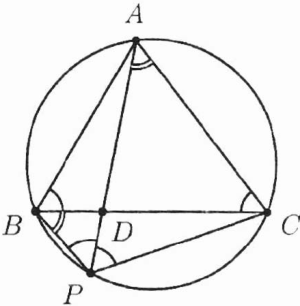
A line drawn from the vertex A of an equilateral triangle ABC meets the side BC at D and the circumcircle at P. Show that ∣PD∣1=∣PB∣1+∣PC∣1
Solution
Because ∠PAC=∠PBC, ∠APC=∠ABC=60∘ and ∠BPA=∠BCA=60∘ the triangles APC and BPD are similar. Thus ∣PB∣∣PA∣=∣PD∣∣PC∣, so ∣PA∣⋅∣PD∣=∣PB∣⋅∣PC∣(1) Since ABPC is a cyclic quadrilateral, ∣PA∣⋅∣BC∣=∣PB∣⋅∣AC∣+∣PC∣⋅∣AB∣. But the triangle ABC is equilateral so it follows that ∣PA∣=∣PB∣+∣PC∣(2) From the two equations (1) and (2), it follows that ∣PB∣⋅∣PC∣=∣PD∣(∣PB∣+∣PC∣). Now dividing by the product ∣PB∣⋅∣PD∣⋅∣PC∣, we get the desired equality ∣PD∣1=∣PB∣1+∣PC∣1
Want a route through all this instead of an archive? The track
puts 2,604 problems in a working order, from Junior Challenge level to the IMO shortlist.
Source: MathNet,
licensed CC-BY-4.0.
Statement reproduced verbatim; metadata (topic, difficulty) added by this project.